
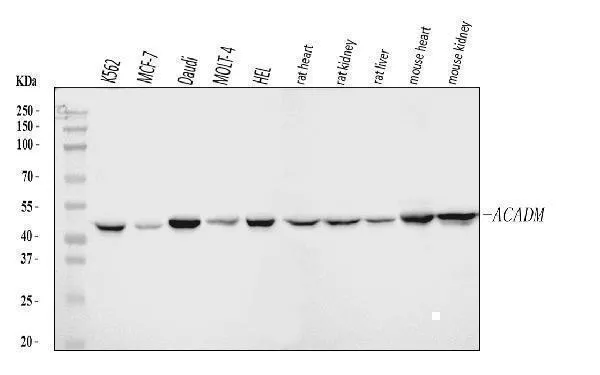
Anti-ACADM/MCAD Antibody Picoband®
Kwaliteit
ISO Gecertificeerd
Levering
24-48 uur
Technische Specificaties
ACADM (acyl-Coenzyme A dehydrogenase, C-4 to C-12 straight chain) is a gene that provides instructions for making an enzyme called acyl-coenzyme A dehydrogenase that is important for breaking down (degrading) a certain group of fats called medium-chain fatty acids. This gene encodes the medium-chain specific (C4 to C12 straight chain) acyl-Coenzyme A dehydrogenase. The homotetramer enzyme catalyzes the initial step of the mitochondrial fatty acid beta-oxidation pathway. Defects in this gene cause medium-chain acyl-CoA dehydrogenase deficiency, a disease characterized by hepatic dysfunction, fasting hypoglycemia, and encephalopathy, which can result in infantile death. Alternatively spliced transcript variants encoding different isoforms have been found for this gene.
Boster Bio Anti-ACADM/MCAD Antibody Picoband® catalog # A02383-3. Tested in ELISA, Flow Cytometry, IF, IHC, ICC, WB applications. This antibody reacts with Human, Mouse, Rat. The brand Picoband indicates this is a premium antibody that guarantees superior quality, high affinity, and strong signals with minimal background in Western blot applications. Only our best-performing antibodies are designated as Picoband, ensuring unmatched performance.
DCC-interacting protein 13-alpha; Dip13-alpha; Adapter protein containing PH domain, PTB domain and leucine zipper motif 1; APPL1; APPL, DIP13A, KIAA1428
ACADM
34
P11310
• Rabbit
Human, Mouse, Rat
No cross-reactivity with other proteins
E.coli-derived human ACADM/MCAD recombinant protein (Position: S38-E401) .
• Polyclonal
High levels in heart, ovary, pancreas and skeletal muscle.
WB, IHC, ICC, IF, Flow Cytometry, ELISA
Calcium Binding Proteins, Calcium Signaling, Neuroscience, Neurotransmission
Immunogen affinity purified.
Adding 0.2 ml of distilled water will yield a concentration of 500 μg/ml.
Lyophilized
Adding 0.2 ml of distilled water will yield a concentration of 500 μg/ml.
Multifunctional adapter protein that binds to various membrane receptors, nuclear factors and signaling proteins to regulate many processes, such as cell proliferation, immune response, endosomal trafficking and cell metabolism (PubMed:26583432, PubMed:15016378, PubMed:26073777, PubMed:19661063, PubMed:10490823) . Regulates signaling pathway leading to cell proliferation through interaction with RAB5A and subunits of the NuRD/MeCP1 complex (PubMed:15016378) . Functions as a positive regulator of innate immune response via activation of AKT1 signaling pathway by forming a complex with APPL1 and PIK3R1 (By similarity) . Inhibits Fc-gamma receptor-mediated phagocytosis through PI3K/Akt signaling in macrophages (By similarity) . Regulates TLR4 signaling in activated macrophages (By similarity) . Involved in trafficking of the TGFBR1 from the endosomes to the nucleus via microtubules in a TRAF6-dependent manner (PubMed:26583432) . Plays a role in cell metabolism by regulating adiponecting and insulin signaling pathways (PubMed:26073777, PubMed:19661063, PubMed:24879834) . Required for fibroblast migration through HGF cell signaling (By similarity) . Positive regulator of beta-catenin/TCF-dependent transcription through interaction with RUVBL2/reptin resulting in the relief of RUVBL2-mediated repression of beta-catenin/TCF target genes by modulating the interactions within the beta-catenin-reptin-HDAC complex (PubMed:19433865) .
1. Albers, S., Levy, H. L., Irons, M., Strauss, A. W., Marsden, D. Compound heterozygosity in four asymptomatic siblings with medium-chain acyl-CoA dehydrogenase deficiency. J. Inherit. Metab. Dis. 24: 417-418, 2001. 2. Andresen, B. S., Bross, P., Udvari, S., Kirk, J., Gray, G., Kmoch, S., Chamoles, N., Knudsen, I., Winter, V., Wilcken, B., Yokota, I., Hart, K., Packman, S., Harpey, J. P., Saudubray, J. M., Hale, D. E., Bolund, L., Kolvraa, S., Gregersen, N. The molecular basis of medium-chain acyl-CoA dehydrogenase (MCAD) deficiency in compound heterozygous patients: is there correlation between genotype and phenotype? Hum. Molec. Genet. 6: 695-707, 1997. 3. Andresen, B. S., Dobrowolski, S. F., O'Reilly, L., Muenzer, J., McCandless, S. E., Frazier, D. M., Udvari, S., Bross, P., Knudsen, I., Banas, R., Chace, D. H., Engel, P., Naylor, E. W., Gregersen, N. Medium-chain acyl-CoA dehydrogenase (MCAD) mutations identified by MS/MS-based prospective screening of newborns differ from those observed in patients with clinical symptoms: identification and characterization of a new, prevalent mutation that results in mild MCAD deficiency. Am. J. Hum. Genet. 68: 1408-1418, 2001.
At -20°C for one year from date of receipt. After reconstitution, at 4°C for one month. It can also be aliquotted and stored frozen at -20°C for six months. Avoid repeated freezing and thawing.
https://www.bosterbio.com/msds?sku=A02383-3
15126 MW
47 kDa
6
Adaptor protein, phosphotyrosine interacting with PH domain and leucine zipper 1
Nucleus; Early endosome membrane; Peripheral membrane protein; Endosome; Cytoplasm; ruffle; phagosome
Fatty acid-binding protein, intestinal
Rabbit IgG
Each vial contains 4 mg Trehalose, 0.9 mg NaCl, 0.2 mg Na2HPO4.
Beschrijving
Boster Bio Anti-ACADM/MCAD Antibody Picoband® catalog # A02383-3. Tested in ELISA, Flow Cytometry, IF, IHC, ICC, WB applications. This antibody reacts with
Specificaties
Recent bekeken producten

Recombinant TAFV GP1 Protein, C-Fc
EVV03609
100 μg
Gabbr1 Mouse Monoclonal Antibody [Clone ID: S93A-49]
TA326530
100 µg
BSA-Myc/DDK Control Protein
AR100025
50 µL
NH-6
ABC-TC0826
1 Vial
Anti-TAT (Thrombin-antithrombin) Antibody
ABS 014-22-1
1000 µL
Anti-APOE2 mouse monoclonal antibody
TD-AB0132
100 µg
CD35 (CR1) mouse monoclonal antibody, clone J3D3, Azide Free
BM2364
0.2 mg
Anti-KIR2DL1 (Rabbit, Monoclonal, Rabbit mAb)
A115392
100 µL
Recent gezochte producten
RFP500 Absorbent Pads
813943
100 Box (100 Sheet (s) x 1 Box)
Zfp507 ORF Vector (Rat) (pORF)
51000016
1.0 µg DNA
ZFP507 Adenovirus (Rat)
51000056
1.0 mL
Zfp507 ORF Vector (Rat) (pORF)
ORF079473
1.0 µg DNA
NRIP2 Peptide (AAP50702)
AAP50702-100UG
100 µg
Lentiviral mouse Zfp507 shRNA (UAS) - Lentiviral mouse Zfp507 shRNA (UAS, RFP) (25)
GTR15246683
1 Vial
Lentiviral mouse Zfp507 shRNA (UAS) - Lentiviral mouse Zfp507 shRNA (UAS, RFP) (100)
GTR15246684
1 Vial
Lentiviral mouse Zfp507 shRNA (UAS) - Lentiviral mouse Zfp507 shRNA (UAS, iRFP) (25)
GTR15246686
1 Vial