
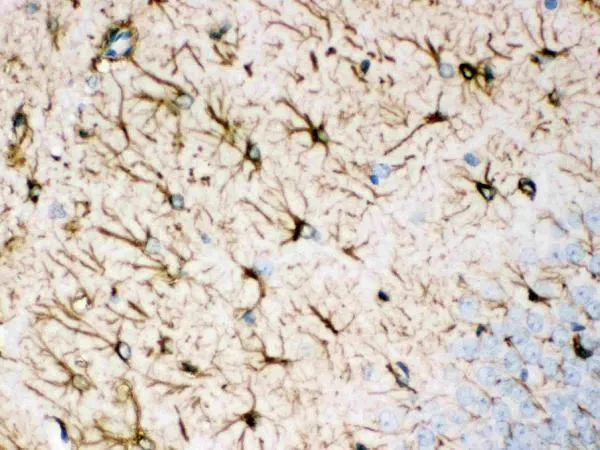
Anti-GFAP-antilichaam (monoclonaal, G-A-5)
Kwaliteit
ISO Gecertificeerd
Levering
24-48 uur
Technische Specificaties
Glial fibrillary acidic protein (GFAP) is an intermediate filament protein of 52Kda. GFAP gene is mapped to human 17q21. GFAP is a useful marker of astroglia in the brain. Mutations in GFAP, encoding glial fibrillary acidic protein, are associated with Alexander disease.
Boster Bio Anti-GFAP Antibody (Monoclonal, G-A-5) catalog # MA1045. Tested in IF, IHC, IHC-F, WB applications. This antibody reacts with Human, Mouse, Pig, Rat.
Glial fibrillary acidic protein; GFAP; Gfap
GFAP
Human (2670), Mouse (14580), Rat (24387)
P47819
• Mouse
Human, Mouse, Pig, Rat
No cross-reactivity with other proteins
GFAP from pig spinal cord.
• Monoclonal
Clone: G-A-5
Expressed in the cortex and hippocampus. Expression decreases following acute and chronic corticosterone treatment. .
IF, IHC, IHC-F, WB
Cell Adhesion Proteins, Cell Type Marker, Cell Type Markers, Cytoskeleton, Cytoskeleton/ECM, Intermediate Filaments, Neural Stem Cells, Neuroscience, Signal Transduction, Stem Cells, Tags & Cell Markers
Ascites
Adding 1 ml of PBS buffer will yield a concentration of 100 μg/ml.
Lyophilized
Add 1ml of PBS buffer will yield a concentration of 100ug/ml.
GFAP, a class-III intermediate filament, is a cell- specific marker that, during the development of the central nervous system, distinguishes astrocytes from other glial cells.
1. Brenner, M.; Johnson, A. B.; Boespflug-Tanguy, O.; Rodriguez, D.; Goldman, J. E.; Messing, A. : Mutations in GFAP, encoding glial fibrillary acidic protein, are associated with Alexander disease. Nature Genet. 27: 117-120, 2001. 2. Rodriguez, D.; Gauthier, F.; Bertini, E.; Bugiani, M.; Brenner, M.; N'guyen, S.; Goizet, C.; Gelot, A.; Surtees, R.; Pedespan, J.-M.; Hernandorena, X.; Troncoso, M.; Uziel, G.; Messing, A.; Ponsot, G.; Pham-Dinh, D.; Dautigny, A.; Boespflug-Tanguy, O. : Infantile Alexander disease: spectrum of GFAP mutations and genotype-phenotype correlation. Am. J. Hum. Genet. 69: 1134-1140, 2001. Note: Erratum: Am. J. Hum. Genet. 69: 1413 only, 2001.
Store at -20°C for one year from date of receipt. After reconstitution, at 4°C for one month. It can also be aliquotted and stored frozen at -20°C for six months. Avoid repeated freeze-thaw cycles.
https://www.bosterbio.com/msds?sku=MA1045
49957 MW
50 kDa
No cross reactivity with other proteins.
Glial fibrillary acidic protein
Cytoplasm . Associated with intermediate filaments. .
Belongs to the intermediate filament family.
Glial fibrillary acidic protein
Mouse IgG1
Mouse ascites fluid, 1.2% sodium acetate, 2mg BSA, with 0.01mg NaN3 as preservative.
Beschrijving
Boster Bio Anti-GFAP Antibody (Monoclonal, G-A-5) catalog # MA1045. Tested in IF, IHC, IHC-F, WB applications. This antibody reacts with Human, Mouse, Pig, Rat.
Specificaties
Recent bekeken producten

Biotin-Recombinant (sf9) Marburg virus glycoprotein (Musoke, HA-tag, >95%), purified
MVGP16-BTN
100 µL
MARV VP40/Marburg VP40 Protein (N-His, Lake Victoria marburgvirus (strain Musoke-80) (MARV) (Marburg virus (strain Kenya/Musoke/1980) ) )
P505862
100 µg
Hettich Centrifuge Rotanta 460R Refrigerated Large Volume
CEN0703
1 Each
X4RF Refrigerated Centrifuge
75009936
1 Each
Drug Stability Chamber
500-DSC102
1 Unit
Modular Incubator Chamber
MIC-101
1 Unit
CYP707A2 Antibody
GTR17947107
2 mg

SsDNA Assay Kit
12645ES60
100 Tests
Recent gezochte producten
Biotin-Recombinant (sf9) Marburg virus glycoprotein (Musoke, HA-tag, >95%), purified
MVGP16-BTN
100 µL
MARV VP40/Marburg VP40 Protein (N-His, Lake Victoria marburgvirus (strain Musoke-80) (MARV) (Marburg virus (strain Kenya/Musoke/1980) ) )
P505862
100 µg
X4RF Refrigerated Centrifuge
75009936
1 Each
Low Speed Refrigerated Centrifuge
LX104LSR
1 Unit
Low Speed Refrigerated Centrifuge
LX117LSR
1 Unit
Low Speed Refrigerated Centrifuge
LX124LSR
1 Unit
Blood Bank Refrigerator
LX4000BBR
1 Unit
Blood Bank Refrigerator
LX4002BBR
1 Unit