
Anti-IDH1 Konijn Monoklonale Antilichaam
Kwaliteit
ISO Gecertificeerd
Levering
24-48 uur
Technische Specificaties
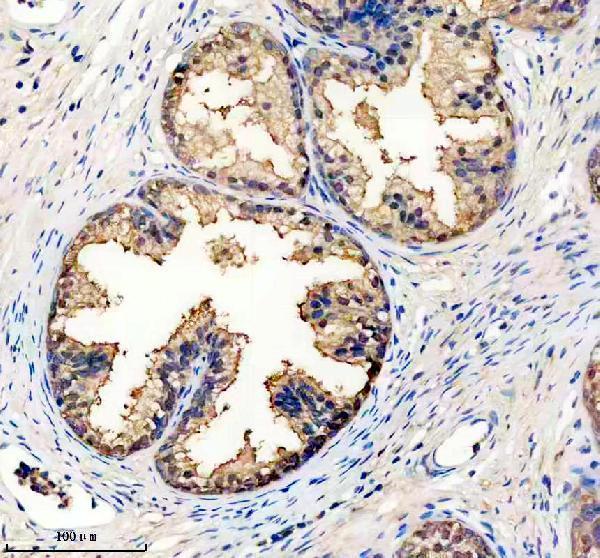
Boster Bio Anti-IDH1 Rabbit Monoclonal Antibody catalog # M00129-2. Tested in WB, IHC, IP applications. This antibody reacts with Human, Mouse, Rat.
E3 ubiquitin-protein ligase parkin; Parkin;6.3.2.-; Parkinson juvenile disease protein 2; Parkinson disease protein 2; PARK2; PRKN
IDH1
3417
O75874
• Rabbit
Human, Mouse, Rat
A synthesized peptide derived from human IDH1
• Monoclonal
Clone: 23I10
Highly expressed in the brain including the substantia nigra. Expressed in heart, testis and skeletal muscle. Expression is down-regulated or absent in tumor biopsies, and absent in the brain of PARK2 patients. Overexpression protects dopamine neurons from kainate-mediated apoptosis. Found in serum (at protein level) . .
WB, IHC, IP
Cell Biology, Metabolism, Mitochondrial Metabolism, Neurodegenerative Disease, Neurology Process, Neuroscience, Pathways and Processes, Proteasome / Ubiquitin, Proteolysis/Ubiquitin, Ring Finger E3 Ligase, Ubiquitin E3 Enzymes
Affinity-chromatography
0.5mg/ml
Liquid
Functions within a multiprotein E3 ubiquitin ligase complex, catalyzing the covalent attachment of ubiquitin moieties onto substrate proteins, such as BCL2, SYT11, CCNE1, GPR37, RHOT1/MIRO1, MFN1, MFN2, STUB1, SNCAIP, SEPT5, TOMM20, USP30, ZNF746 and AIMP2 (PubMed:10973942, PubMed:10888878, PubMed:11431533, PubMed:12150907, PubMed:12628165, PubMed:16135753, PubMed:21376232, PubMed:23754282, PubMed:23620051, PubMed:24660806, PubMed:24751536) . Mediates monoubiquitination as well as 'Lys-6', 'Lys-11', 'Lys-48'-linked and 'Lys-63'-linked polyubiquitination of substrates depending on the context (PubMed:19229105, PubMed:20889974, PubMed:25621951) . Participates in the removal and/or detoxification of abnormally folded or damaged protein by mediating 'Lys-63'-linked polyubiquitination of misfolded proteins such as PARK7: 'Lys-63'- linked polyubiquitinated misfolded proteins are then recognized by HDAC6, leading to their recruitment to aggresomes, followed by degradation (PubMed:17846173, PubMed:19229105) . Mediates 'Lys-63'- linked polyubiquitination of a 22 kDa O-linked glycosylated isoform of SNCAIP, possibly playing a role in Lewy-body formation (PubMed:11590439, PubMed:11431533, PubMed:19229105, PubMed:11590439, PubMed:15728840) . Mediates monoubiquitination of BCL2, thereby acting as a positive regulator of autophagy (PubMed:20889974) . Promotes the autophagic degradation of dysfunctional depolarized mitochondria (mitophagy) by promoting the ubiquitination of mitochondrial proteins such as TOMM20, RHOT1/MIRO1 and USP30 (PubMed:19029340, PubMed:19966284, PubMed:23620051, PubMed:24896179, PubMed:25527291) . Preferentially assembles 'Lys-6'-, 'Lys-11'- and 'Lys-63'-linked polyubiquitin chains following mitochondrial damage, leading to mitophagy (PubMed:25621951) . Mediates 'Lys-48'-linked polyubiquitination of ZNF746, followed by degradation of ZNF746 by the proteasome; possibly playing a role in the regulation of neuron death (PubMed:21376232) . Limits the production of reactive oxygen species (ROS) . Regulates cyclin-E during neuronal apoptosis. In collaboration with CHPF isoform 2, may enhance cell viability and protect cells from oxidative stress (PubMed:22082830) . Independently of its ubiquitin ligase activity, protects from apoptosis by the transcriptional repression of p53/TP53 (PubMed:19801972) . May protect neurons against alpha synuclein toxicity, proteasomal dysfunction, GPR37 accumulation, and kainate-induced excitotoxicity (PubMed:11439185) . May play a role in controlling neurotransmitter trafficking at the presynaptic terminal and in calcium-dependent exocytosis. May represent a tumor suppressor gene. .
Store at -20°C for one year. For short term storage and frequent use, store at 4°C for up to one month. Avoid repeated freeze-thaw cycles.
https://www.bosterbio.com/msds?sku=M00129-2
51641 MW
47 kDa
E3 ubiquitin-protein ligase parkin
Cytoplasm, cytosol . Nucleus. Endoplasmic reticulum. Mitochondrion . Mainly localizes in the cytosol. Co-localizes with SYT11 in neutrites. Co-localizes with SNCAIP in brainstem Lewy bodies. Mitochondrial localization gradually increases with cellular growth. Also relocates to dysfunctional mitochondria that have lost the mitochondrial membrane potential; recruitment to mitochondria is PINK1- dependent.
P2X purinoceptor 1
IgG
Rabbit IgG in phosphate buffered saline, pH 7.4, 150mM NaCl, 0.02% sodium azide and 50% glycerol, 0.4-0.5mg/ml BSA.
Beschrijving
Boster Bio Anti-IDH1 Rabbit Monoclonal Antibody catalog # M00129-2. Tested in WB, IHC, IP applications. This antibody reacts with Human, Mouse, Rat.
Specificaties
Recent bekeken producten

Recombinant TAFV GP1 Protein, C-Fc
EVV03609
100 μg
Gabbr1 Mouse Monoclonal Antibody [Clone ID: S93A-49]
TA326530
100 µg
BSA-Myc/DDK Control Protein
AR100025
50 µL
NH-6
ABC-TC0826
1 Vial
Anti-TAT (Thrombin-antithrombin) Antibody
ABS 014-22-1
1000 µL
Anti-APOE2 mouse monoclonal antibody
TD-AB0132
100 µg
CD35 (CR1) mouse monoclonal antibody, clone J3D3, Azide Free
BM2364
0.2 mg
Anti-KIR2DL1 (Rabbit, Monoclonal, Rabbit mAb)
A115392
100 µL
Recent gezochte producten
Recombinant TAFV GP1 Protein, C-Fc
EVV03609
100 μg
Fluorescein Conjugated Affinity Purified Anti-MOUSE IgG + IgM (H&L) (GOAT) Minimum Cross Reactivity to Bovine, Horse and Human S
GWB-5CB439
1 mg
Horse Polyclonal Horse anti-Goat IgG ImmPRESS(TM) Secondary Antibody [HRP Polymer]
MP-7405-NB-50mL
50 mL
Horse Polyclonal Horse anti-Rabbit IgG ImmPRESS(TM) Secondary Antibody [HRP Polymer]
MP-7401-NB-15mL
15 mL
Horse Polyclonal Horse anti-Mouse IgG ImmPRESS(TM) Secondary Antibody [AP Polymer]
MP-5402-NB-50mL
50 mL
Horse Polyclonal Horse anti-Goat IgG ImmPRESS(TM) Secondary Antibody [HRP Polymer]
MP-7405-NB-15mL
15 mL
Horse Polyclonal Horse anti-Mouse ImmPRESS(TM) VR Secondary Antibody [HRP Polymer]
MP-6402-NB
15 mL
Horse Polyclonal Horse anti-Mouse IgG ImmPRESS(TM) Secondary Antibody [AP Polymer]
MP-5402-NB-15mL
15 mL