
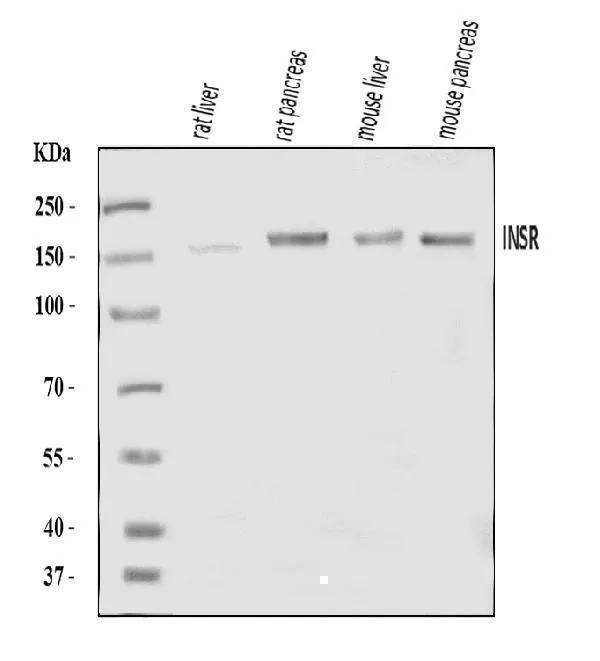
Anti-Insulin receptor/INSR Antibody Picoband®
Kwaliteit
ISO Gecertificeerd
Levering
24-48 uur
Technische Specificaties
INSR (INSULIN RECEPTOR) is a tetramer of 2 alpha and 2 beta subunits that are coded by a single gene and are joined by disulfide bonds, a mechanism parallel to that of its ligand, insulin. It belongs to the large class of tyrosine kinase receptors. The insulin receptor gene is mapped to 19p13.2. The insulin receptor mediates their activity by causing the addition of a phosphate group to particular tyrosines on certain proteins within a cell. The INSR gene spans more than 120 kb and has 22 exons. Functional studies of the INSR SNPs show no effect on mRNA levels or splicing in peripheral blood leukocytes or on binding of insulin to mononuclear cells.
Boster Bio Anti-Insulin Receptor/INSR Antibody Picoband® catalog # A00447-2. Tested in ELISA, WB applications. This antibody reacts with Human, Mouse, Rat. The brand Picoband indicates this is a premium antibody that guarantees superior quality, high affinity, and strong signals with minimal background in Western blot applications. Only our best-performing antibodies are designated as Picoband, ensuring unmatched performance.
RAF proto-oncogene serine/threonine-protein kinase;2.7.11.1; Proto-oncogene c-RAF; cRaf; Raf-1; RAF1; RAF
INSR
3643
P06213
• Rabbit
Human, Mouse, Rat
No cross-reactivity with other proteins.
E.coli-derived human Insulin Receptor/INSR recombinant protein (Position: E168-N621) .
• Polyclonal
In skeletal muscle, isoform 1 is more abundant than isoform 2. .
WB, ELISA
Oncoproteins/Suppressors, Pathways and Processes, Protein Phosphorylation, Ser/Thr Kinases, Signal Transduction
Immunogen affinity purified.
Adding 0.2 ml of distilled water will yield a concentration of 500 μg/ml.
Lyophilized
Adding 0.2 ml of distilled water will yield a concentration of 500 μg/ml.
Serine/threonine-protein kinase that acts as a regulatory link between the membrane-associated Ras GTPases and the MAPK/ERK cascade, and this critical regulatory link functions as a switch determining cell fate decisions including proliferation, differentiation, apoptosis, survival and oncogenic transformation. RAF1 activation initiates a mitogen-activated protein kinase (MAPK) cascade that comprises a sequential phosphorylation of the dual-specific MAPK kinases (MAP2K1/MEK1 and MAP2K2/MEK2) and the extracellular signal-regulated kinases (MAPK3/ERK1 and MAPK1/ERK2) . The phosphorylated form of RAF1 (on residues Ser-338 and Ser-339, by PAK1) phosphorylates BAD/Bcl2- antagonist of cell death at 'Ser-75'. Phosphorylates adenylyl cyclases: ADCY2, ADCY5 and ADCY6, resulting in their activation. Phosphorylates PPP1R12A resulting in inhibition of the phosphatase activity. Phosphorylates TNNT2/cardiac muscle troponin T. Can promote NF-kB activation and inhibit signal transducers involved in motility (ROCK2), apoptosis (MAP3K5/ASK1 and STK3/MST2), proliferation and angiogenesis (RB1) . Can protect cells from apoptosis also by translocating to the mitochondria where it binds BCL2 and displaces BAD/Bcl2-antagonist of cell death. Regulates Rho signaling and migration, and is required for normal wound healing. Plays a role in the oncogenic transformation of epithelial cells via repression of the TJ protein, occludin (OCLN) by inducing the up-regulation of a transcriptional repressor SNAI2/SLUG, which induces down-regulation of OCLN. Restricts caspase activation in response to selected stimuli, notably Fas stimulation, pathogen-mediated macrophage apoptosis, and erythroid differentiation. .
1. Accili, D., Drago, J., Lee, E. J., Johnson, M. D., Cool, M. H., Salvatore, P., Asico, L. D., Jose, P. A., Taylor, S. I., Westphal, H. Early neonatal death in mice homozygous for a null allele of the insulin receptor gene. Nature Genet. 12: 106-109, 1996. 2. 't Hart, L. M., Stolk, R. P., Dekker, J. M., Nijpels, G., Grobbee, D. E., Heine, R. J., Maassen, J. A. Prevalence of variants in candidate genes for type 2 diabetes mellitus in the Netherlands: the Rotterdam study and the Hoorn study. J. Clin. Endocr. Metab. 84: 1002-1006, 1999. 3. Ward CW, Lawrence MC (April 2009) . Ligand-induced activation of the insulin receptor: a multi-step process involving structural changes in both the ligand and the receptor.
At -20°C for one year from date of receipt. After reconstitution, at 4°C for one month. It can also be aliquotted and stored frozen at -20°C for six months. Avoid repeated freezing and thawing.
https://www.bosterbio.com/msds?sku=A00447-2
73052 MW
156 kDa
RAF proto-oncogene serine/threonine-protein kinase
Cytoplasm. Cell membrane. Mitochondrion. Nucleus. Colocalizes with RGS14 and BRAF in both the cytoplasm and membranes. Phosphorylation at Ser-259 impairs its membrane accumulation. Recruited to the cell membrane by the active Ras protein. Phosphorylation at Ser-338 and Ser-339 by PAK1 is required for its mitochondrial localization. Retinoic acid- induced Ser-621 phosphorylated form of RAF1 is predominantly localized at the nucleus.
Rabbit IgG
Each vial contains 4 mg Trehalose, 0.9 mg NaCl, 0.2 mg Na2HPO4.
Beschrijving
Boster Bio Anti-Insulin Receptor/INSR Antibody Picoband® catalog # A00447-2. Tested in ELISA, WB applications. This antibody reacts with Human, Mouse, Rat.
Specificaties
Recent bekeken producten

Cellubrevin Antibody
MBS9436639-01
0.05 mL
Oxidative Stress Combo Assay Tissue Kit
EA-7008
1 Each
Arachis hypogaea Lectin (PNA) - Biotinylated
21510020-1
5mg
1,4- Dioxane Pure
1041330 500
500 mL
Benzonase ELISA Kit
EG23601S
96 Tests

Not I Restriction Enzyme
B2016623
500 Units
K562-HLA-G0101 Overexpressing Cell Line
RG-1214
5x 10^6
Yeast Poly (A) Polymerase
RNT-006-S
30000 Units
Recent gezochte producten
Cellubrevin Antibody
MBS9436639-01
0.05 mL
Rat Oxidative Stress Primer Library
ROSL-I
1 set
DTNB (Ellman’s) Thiol Oxidative Stress Assay
1021
1 Kit
OSR1 (Oxidative Stress Responsive 1)
MBS616581-01
0.1 mL
Oxidative Stress Combo Assay Cell Kit
EA-7006
1 Each
Oxidative Stress Combo Assay Blood Kit
EA-7007
1 Each
Oxidative Stress Combo Assay Tissue Kit
EA-7008
1 Each
OSR1 (Oxidative Stress Responsive 1)
O8054
100 µL