
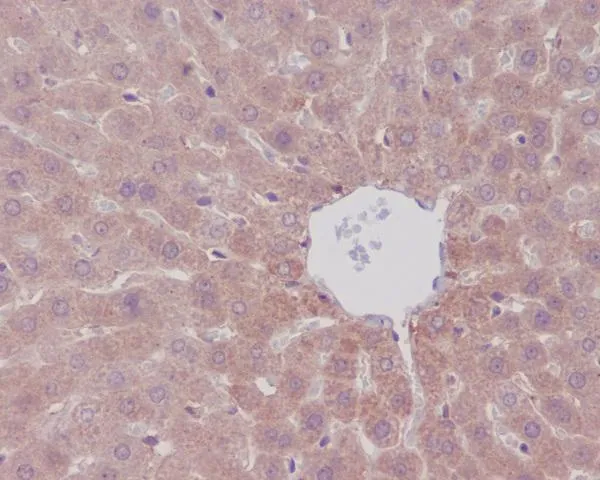
Anti-mTOR/Tor Konijn Monoklonale Antilichaam
Kwaliteit
ISO Gecertificeerd
Levering
24-48 uur
Technische Specificaties
Boster Bio Anti-mTOR/Tor Rabbit Monoclonal Antibody catalog # M00003. Tested in WB, IHC, ICC/IF, IP, Flow Cytometry applications. This antibody reacts with Human, Mouse, Rat.
Serine/threonine-protein kinase mTOR;2.7.11.1; FK506-binding protein 12-rapamycin complex-associated protein 1; FKBP12-rapamycin complex-associated protein; Mammalian target of rapamycin; mTOR; Mechanistic target of rapamycin; Rapamycin and FKBP12 target 1; Rapamycin target protein 1; MTOR; FRAP, FRAP1, FRAP2, RAFT1, RAPT1
MTOR
2475
P42345
• Rabbit
Human, Mouse, Rat
A synthesized peptide derived from human mTOR
• Monoclonal
Clone: CBD-13
Expressed in numerous tissues, with highest levels in testis. .
WB, IHC, ICC, IF, IP, Flow Cytometry
Cancer, Cardiogenesis, Cardiovascular, Cell Biology, Cell Cycle, Cell Cycle Inhibitors, DNA/RNA, DNA Damage & Repair, DNA Damage Response, Epigenetics and Nuclear Signaling, Metabolism, Obesity, Transcription Factors/Regulators
Affinity-chromatography
0.5mg/ml
Liquid
Serine/threonine protein kinase which is a central regulator of cellular metabolism, growth and survival in response to hormones, growth factors, nutrients, energy and stress signals. MTOR ly or inly regulates the phosphorylation of at least 800 proteins. Functions as part of 2 structurally and functionally distinct signaling complexes mTORC1 and mTORC2 (mTOR complex 1 and 2) . Activated mTORC1 up-regulates protein synthesis by phosphorylating key regulators of mRNA translation and ribosome synthesis. This includes phosphorylation of EIF4EBP1 and release of its inhibition toward the elongation initiation factor 4E (eiF4E) . Moreover, phosphorylates and activates RPS6KB1 and RPS6KB2 that promote protein synthesis by modulating the activity of their downstream targets including ribosomal protein S6, eukaryotic translation initiation factor EIF4B, and the inhibitor of translation initiation PDCD4. Stimulates the pyrimidine biosynthesis pathway, both by acute regulation through RPS6KB1- mediated phosphorylation of the biosynthetic enzyme CAD, and delayed regulation, through transcriptional enhancement of the pentose phosphate pathway which produces 5-phosphoribosyl-1- pyrophosphate (PRPP), an allosteric activator of CAD at a later step in synthesis, this function is dependent on the mTORC1 complex. Regulates ribosome synthesis by activating RNA polymerase III-dependent transcription through phosphorylation and inhibition of MAF1 an RNA polymerase III-repressor. In parallel to protein synthesis, also regulates lipid synthesis through SREBF1/SREBP1 and LPIN1. To maintain energy homeostasis mTORC1 may also regulate mitochondrial biogenesis through regulation of PPARGC1A. mTORC1 also negatively regulates autophagy through phosphorylation of ULK1. Under nutrient sufficiency, phosphorylates ULK1 at 'Ser- 758', disrupting the interaction with AMPK and preventing activation of ULK1. Also prevents autophagy through phosphorylation of the autophagy inhibitor DAP. mTORC1 exerts a feedback control on upstream growth factor signaling that includes phosphorylation and activation of GRB10 a INSR-dependent signaling suppressor. Among other potential targets mTORC1 may phosphorylate CLIP1 and regulate microtubules. As part of the mTORC2 complex MTOR may regulate other cellular processes including survival and organization of the cytoskeleton. Plays a critical role in the phosphorylation at 'Ser-473' of AKT1, a pro-survival effector of phosphoinositide 3-kinase, facilitating its activation by PDK1. mTORC2 may regulate the actin cytoskeleton, through phosphorylation of PRKCA, PXN and activation of the Rho-type guanine nucleotide exchange factors RHOA and RAC1A or RAC1B. mTORC2 also regulates the phosphorylation of SGK1 at 'Ser-422'. Regulates osteoclastogensis by adjusting the expression of CEBPB isoforms (By similarity) . .
Store at -20°C for one year. For short term storage and frequent use, store at 4°C for up to one month. Avoid repeated freeze-thaw cycles.
https://www.bosterbio.com/msds?sku=M00003
288892 MW
289 kDa
Serine/threonine-protein kinase mTOR
Endoplasmic reticulum membrane ; Peripheral membrane protein ; Cytoplasmic side . Golgi apparatus membrane ; Peripheral membrane protein ; Cytoplasmic side . Mitochondrion outer membrane ; Peripheral membrane protein ; Cytoplasmic side . Lysosome . Cytoplasm . Nucleus, PML body . Microsome membrane . Shuttles between cytoplasm and nucleus. Accumulates in the nucleus in response to hypoxia (By similarity) . Targeting to lysosomes depends on amino acid availability and RRAGA and RRAGB (PubMed:18497260, PubMed:20381137) . .
P2X purinoceptor 1
Rabbit IgG
Rabbit IgG in phosphate buffered saline, pH 7.4, 150mM NaCl, 0.02% sodium azide and 50% glycerol, 0.4-0.5mg/ml BSA.
Beschrijving
Boster Bio Anti-mTOR/Tor Rabbit Monoclonal Antibody catalog # M00003. Tested in WB, IHC, ICC/IF, IP, Flow Cytometry applications. This antibody reacts with Huma
Specificaties
Recent bekeken producten

MARV VP40/Marburg VP40 Protein (N-His, Lake Victoria marburgvirus (strain Musoke-80) (MARV) (Marburg virus (strain Kenya/Musoke/1980) ) )
P505862
100 µg
Drug Stability Chamber
500-DSC102
1 Unit
Modular Incubator Chamber
MIC-101
1 Unit
CYP707A2 Antibody
GTR17947107
2 mg

SsDNA Assay Kit
12645ES60
100 Tests
Eco Alu MTP (HxD) 6x7=42 plates 35mm, 223x630x135mm
TE15336
1 Piece
Arachis hypogaea Lectin (PNA) - Biotinylated
21510020-1
5mg
Cellubrevin Antibody
MBS9436639-01
0.05 mL
Recent gezochte producten
MARV VP40/Marburg VP40 Protein (N-His, Lake Victoria marburgvirus (strain Musoke-80) (MARV) (Marburg virus (strain Kenya/Musoke/1980) ) )
P505862
100 µg
BDBV Nucleoprotein Recombinant Protein (N-His)
VK059012-01
50 µg
KBFP720 700L Stability Chamber
CHA3020
1 Each
KBFLQC240 247L Stability Chamber
CHA3022
1 Each
KBF1020 1020L Stability Chamber
CHA3024
1 Each
Stability Chamber KBFP240 247L
CHA3030
1 Each
Drug Stability Chamber
150-DSC100
1 Unit
Drug Stability Chamber
150-DSC200
1 Unit