
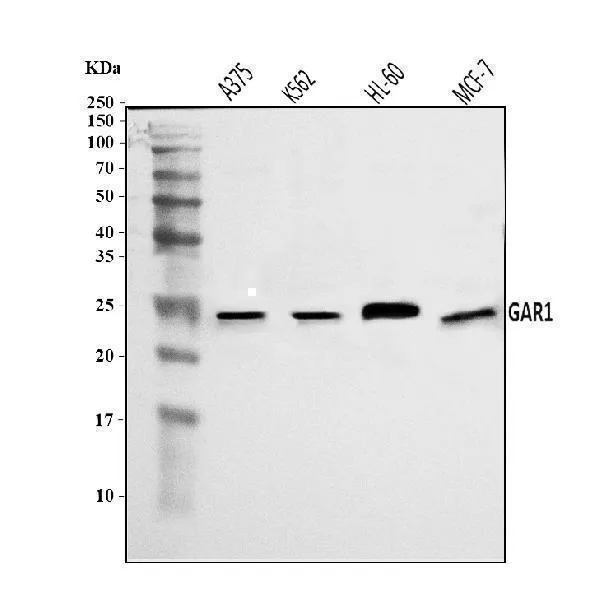
Anti-NOLA1/GAR1 Antibody Picoband®
Kwaliteit
ISO Gecertificeerd
Levering
24-48 uur
Technische Specificaties
H/ACA ribonucleoprotein complex subunit 1 is a protein that in humans is encoded by the GAR1 gene. This gene is a member of the H/ACA snoRNPs (small nucleolar ribonucleoproteins) gene family. snoRNPs are involved in various aspects of rRNA processing and modification and have been classified into two families: C/D and H/ACA. The H/ACA snoRNPs also include the DKC1, NOLA2 and NOLA3 proteins. These four H/ACA snoRNP proteins localize to the dense fibrillar components of nucleoli and to coiled (Cajal) bodies in the nucleus. Both 18S rRNA production and rRNA pseudouridylation are impaired if any one of the four proteins is depleted. These four H/ACA snoRNP proteins are also components of the telomerase complex. The encoded protein of this gene contains two glycine- and arginine-rich domains and is related to Saccharomyces cerevisiae Gar1p. Two splice variants have been found for this gene.
Boster Bio Anti-NOLA1/GAR1 Antibody Picoband® catalog # A07049-1. Tested in ELISA, Flow Cytometry, IP, IF, IHC, ICC, WB applications. This antibody reacts with Human. The brand Picoband indicates this is a premium antibody that guarantees superior quality, high affinity, and strong signals with minimal background in Western blot applications. Only our best-performing antibodies are designated as Picoband, ensuring unmatched performance.
Forkhead box protein F1; Forkhead-related activator 1; FREAC-1; Forkhead-related protein FKHL5; Forkhead-related transcription factor 1; FOXF1; FKHL5; FREAC1
GAR1
54433
Q9NY12
• Rabbit
Human
No cross-reactivity with other proteins.
E.coli-derived human NOLA1/GAR1 recombinant protein (Position: F58-K165) .
• Polyclonal
Expressed in kidney.
WB, IHC, ICC, IF, IP, Flow Cytometry, ELISA
Cell Biology
Immunogen affinity purified.
Adding 0.2 ml of distilled water will yield a concentration of 500 μg/ml.
Lyophilized
Adding 0.2 ml of distilled water will yield a concentration of 500 μg/ml.
Transcriptional regulator involved in different processes such as glucose metabolism, aerobic glycolysis, muscle cell differentiation and autophagy. Recognizes and binds the forkhead DNA sequence motif (5'-GTAAACA-3') and can both act as a transcription activator or repressor, depending on the context. Together with FOXK2, acts as a key regulator of metabolic reprogramming towards aerobic glycolysis, a process in which glucose is converted to lactate in the presence of oxygen. Acts by promoting expression of enzymes for glycolysis (such as hexokinase-2 (HK2), phosphofructokinase, pyruvate kinase (PKLR) and lactate dehydrogenase), while suppressing further oxidation of pyruvate in the mitochondria by up-regulating pyruvate dehydrogenase kinases PDK1 and PDK4. Probably plays a role in gluconeogenesis during overnight fasting, when lactate from white adipose tissue and muscle is the main substrate. Involved in mTORC1-mediated metabolic reprogramming: in response to mTORC1 signaling, translocates into the nucleus and regulates the expression of genes associated with glycolysis and downstream anabolic pathways, such as HIF1A, thereby regulating glucose metabolism. Together with FOXK2, acts as a negative regulator of autophagy in skeletal muscle: in response to starvation, enters the nucleus, binds the promoters of autophagy genes and represses their expression, preventing proteolysis of skeletal muscle proteins. Acts as a transcriptional regulator of the myogenic progenitor cell population in skeletal muscle. Binds to the upstream enhancer region (CCAC box) of myoglobin (MB) gene, regulating the myogenic progenitor cell population. Promotes muscle progenitor cell proliferation by repressing the transcriptional activity of FOXO4, thereby inhibiting myogenic differentiation. Involved in remodeling processes of adult muscles that occur in response to physiological stimuli. Required to correct temporal orchestration of molecular and cellular events necessary for muscle repair. Represses myogenic differentiation by inhibiting MEFC activity. Positively regulates Wnt/beta-catenin signaling by translocating DVL into the nucleus. Reduces virus replication, probably by binding the interferon stimulated response element (ISRE) to promote antiviral gene expression.
1. Dragon, F., Pogacic, V., Filipowicz, W. In vitro assembly of human H/ACA small nucleolar RNPs reveals unique features of U17 and telomerase RNAs. Molec. Cell. Biol. 20: 3037-3048, 2000. 2. Tollervey, D., Kiss, T. Function and synthesis of small nucleolar RNAs. Curr. Opin. Cell Biol. 9: 337-342, 1997.
At -20°C for one year from date of receipt. After reconstitution, at 4°C for one month. It can also be aliquotted and stored frozen at -20°C for six months. Avoid repeated freezing and thawing.
https://www.bosterbio.com/msds?sku=A07049-1
25 kDa
6
Forkhead box K1
Nucleus.
Rabbit IgG
Each vial contains 4 mg Trehalose, 0.9 mg NaCl, 0.2 mg Na2HPO4.
Beschrijving
Boster Bio Anti-NOLA1/GAR1 Antibody Picoband® catalog # A07049-1. Tested in ELISA, Flow Cytometry, IP, IF, IHC, ICC, WB applications. This antibody reacts w
Specificaties
Recent bekeken producten
MARV VP40/Marburg VP40 Protein (N-His, Lake Victoria marburgvirus (strain Musoke-80) (MARV) (Marburg virus (strain Kenya/Musoke/1980) ) )
P505862
100 µg
Drug Stability Chamber
500-DSC102
1 Unit
Modular Incubator Chamber
MIC-101
1 Unit
CYP707A2 Antibody
GTR17947107
2 mg

SsDNA Assay Kit
12645ES60
100 Tests
Eco Alu MTP (HxD) 6x7=42 plates 35mm, 223x630x135mm
TE15336
1 Piece
Arachis hypogaea Lectin (PNA) - Biotinylated
21510020-1
5mg
Cellubrevin Antibody
MBS9436639-01
0.05 mL
Recent gezochte producten
MARV VP40/Marburg VP40 Protein (N-His, Lake Victoria marburgvirus (strain Musoke-80) (MARV) (Marburg virus (strain Kenya/Musoke/1980) ) )
P505862
100 µg
BDBV Nucleoprotein Recombinant Protein (N-His)
VK059012-01
50 µg
KBFP720 700L Stability Chamber
CHA3020
1 Each
KBFLQC240 247L Stability Chamber
CHA3022
1 Each
KBF1020 1020L Stability Chamber
CHA3024
1 Each
Stability Chamber KBFP240 247L
CHA3030
1 Each
Drug Stability Chamber
150-DSC100
1 Unit
Drug Stability Chamber
150-DSC200
1 Unit