
Anti-NUDC Konijn Monoklonale Antilichaam
Kwaliteit
ISO Gecertificeerd
Levering
24-48 uur
Technische Specificaties
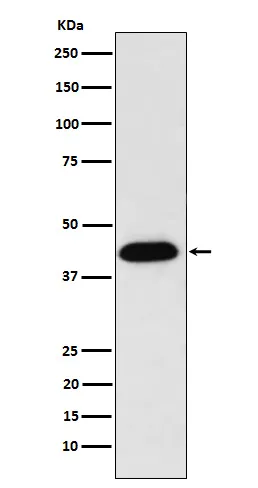
Boster Bio Anti-NUDC Rabbit Monoclonal Antibody catalog # M00995. Tested in WB, IHC, ICC/IF, IP, Flow Cytometry applications. This antibody reacts with Human, Mouse, Rat.
5'-AMP-activated protein kinase catalytic subunit alpha-1; AMPK subunit alpha-1;2.7.11.1 ; Acetyl-CoA carboxylase kinase; ACACA kinase;2.7.11.27 ; Hydroxymethylglutaryl-CoA reductase kinase; HMGCR kinase;2.7.11.31 ; Tau-protein kinase PRKAA1;2.7.11.26; PRKAA1; AMPK1
NUDC
10726
Q9Y266
• Rabbit
Human, Mouse, Rat
A synthesized peptide derived from human NUDC
• Monoclonal
Clone: 22N41
Expressed predominantly in muscle. .
WB, IHC, ICC, IF, IP, Flow Cytometry
Alzheimer's Disease, Cancer, Cancer Metabolism, Cardiovascular, Energy Transfer Pathways, Fatty Acid Oxidation, Fatty Acids, Integration Of Energy, Integration Of Energy Metabolism, Lipid and Lipoprotein Metabolism, Lipids/Lipoproteins, Metabolic Signaling Pathway, Metabolic Signaling Pathways, Metabolism, Metabolism Processes, Neurodegenerative Disease, Neurology Process, Neuroscience, Pathways and Processes, Protein Phosphorylation, Redox Metabolism, Response To Hypoxia, Ser/Thr Kinases, Signal Transduction
Affinity-chromatography
0.5mg/ml
Liquid
Catalytic subunit of AMP-activated protein kinase (AMPK), an energy sensor protein kinase that plays a key role in regulating cellular energy metabolism. In response to reduction of intracellular ATP levels, AMPK activates energy-producing pathways and inhibits energy-consuming processes: inhibits protein, carbohydrate and lipid biosynthesis, as well as cell growth and proliferation. AMPK acts via phosphorylation of metabolic enzymes, and by longer-term effects via phosphorylation of transcription regulators. Also acts as a regulator of cellular polarity by remodeling the actin cytoskeleton; probably by inly activating myosin. Regulates lipid synthesis by phosphorylating and inactivating lipid metabolic enzymes such as ACACA, ACACB, GYS1, HMGCR and LIPE; regulates fatty acid and cholesterol synthesis by phosphorylating acetyl-CoA carboxylase (ACACA and ACACB) and hormone-sensitive lipase (LIPE) enzymes, respectively. Regulates insulin-signaling and glycolysis by phosphorylating IRS1, PFKFB2 and PFKFB3. AMPK stimulates glucose uptake in muscle by increasing the translocation of the glucose transporter SLC2A4/GLUT4 to the plasma membrane, possibly by mediating phosphorylation of TBC1D4/AS160. Regulates transcription and chromatin structure by phosphorylating transcription regulators involved in energy metabolism such as CRTC2/TORC2, FOXO3, histone H2B, HDAC5, MEF2C, MLXIPL/ChREBP, EP300, HNF4A, p53/TP53, SREBF1, SREBF2 and PPARGC1A. Acts as a key regulator of glucose homeostasis in liver by phosphorylating CRTC2/TORC2, leading to CRTC2/TORC2 sequestration in the cytoplasm. In response to stress, phosphorylates 'Ser-36' of histone H2B (H2BS36ph), leading to promote transcription. Acts as a key regulator of cell growth and proliferation by phosphorylating TSC2, RPTOR and ATG1/ULK1: in response to nutrient limitation, negatively regulates the mTORC1 complex by phosphorylating RPTOR component of the mTORC1 complex and by phosphorylating and activating TSC2. In response to nutrient limitation, promotes autophagy by phosphorylating and activating ATG1/ULK1. AMPK also acts as a regulator of circadian rhythm by mediating phosphorylation of CRY1, leading to destabilize it. May regulate the Wnt signaling pathway by phosphorylating CTNNB1, leading to stabilize it. Also has tau-protein kinase activity: in response to amyloid beta A4 protein (APP) exposure, activated by CAMKK2, leading to phosphorylation of MAPT/TAU; however the relevance of such data remains unclear in vivo. Also phosphorylates CFTR, EEF2K, KLC1, NOS3 and SLC12A1. .
Store at -20°C for one year. For short term storage and frequent use, store at 4°C for up to one month. Avoid repeated freeze-thaw cycles.
https://www.bosterbio.com/msds?sku=M00995
64009 MW
42 kDa
5'-AMP-activated protein kinase catalytic subunit alpha-1
Cytoplasm . Nucleus . In response to stress, recruited by p53/TP53 to specific promoters.
Glycogen synthase kinase-3 beta (gsk3b)
IgG
Rabbit IgG in phosphate buffered saline, pH 7.4, 150mM NaCl, 0.02% sodium azide and 50% glycerol, 0.4-0.5mg/ml BSA.
Beschrijving
Boster Bio Anti-NUDC Rabbit Monoclonal Antibody catalog # M00995. Tested in WB, IHC, ICC/IF, IP, Flow Cytometry applications. This antibody reacts with Human, M
Specificaties
Recent bekeken producten

Recombinant TAFV GP1 Protein, C-Fc
EVV03609
100 μg
Gabbr1 Mouse Monoclonal Antibody [Clone ID: S93A-49]
TA326530
100 µg
BSA-Myc/DDK Control Protein
AR100025
50 µL
NH-6
ABC-TC0826
1 Vial
Anti-TAT (Thrombin-antithrombin) Antibody
ABS 014-22-1
1000 µL
Anti-APOE2 mouse monoclonal antibody
TD-AB0132
100 µg
CD35 (CR1) mouse monoclonal antibody, clone J3D3, Azide Free
BM2364
0.2 mg
Anti-KIR2DL1 (Rabbit, Monoclonal, Rabbit mAb)
A115392
100 µL
Recent gezochte producten
Magnesium sulfate, anhydrous
MN1988
250g
pMC.BESPX-MCS1 (empty vector)
MN100A-1
10 µg
19-Norandrosterone D-glucuronide
MN10565
1 mg
Naltrexone 3-D-glucuronide-D4
MN11758
1 g
Naringenin-7-O-b-D-glucuronide
MN16170-01
1 mg
NBD-Fructose
MN167002
10 mg
(2E) -4-[2-Nitro-3-[ (2,3,4,6-tetra-O-acetyl-b-D-glucopyranosyl) oxy]phenyl]-4-oxo-2-butenoic acid methyl ester
MN16816-01
5 mg
Norethindrone b-D-glucuronide
MN16823-01
1 mg