
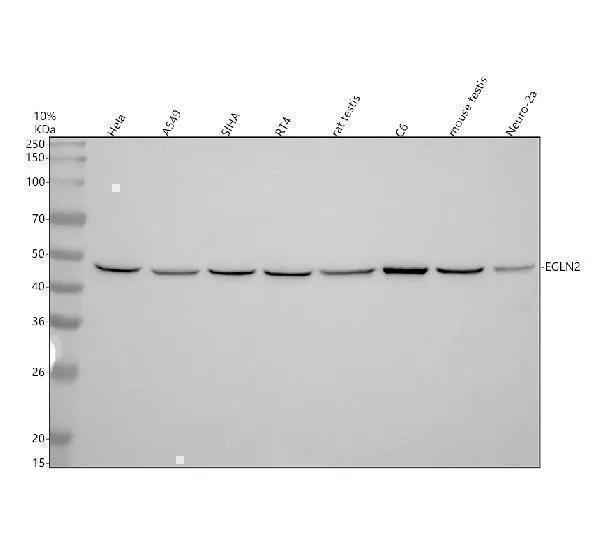
Anti-PHD1/prolylhydroxylase Konijn Monoklonale Antilichaam
Kwaliteit
ISO Gecertificeerd
Levering
24-48 uur
Technische Specificaties
Boster Bio Anti-PHD1/prolyl hydroxylase Rabbit Monoclonal Antibody catalog # M03015. Tested in WB, IHC, ICC/IF, Flow Cytometry applications. This antibody reacts with Human, Mouse, Rat.
Egl nine homolog 2;1.14.11.29; Estrogen-induced tag 6; HPH-3; Hypoxia-inducible factor prolyl hydroxylase 1; HIF-PH1; HIF-prolyl hydroxylase 1; HPH-1; Prolyl hydroxylase domain-containing protein 1; PHD1; EGLN2; EIT6
EGLN2
112398
Q96KS0
• Rabbit
Human, Mouse, Rat
A synthesized peptide derived from human PHD1/prolyl hydroxylase
• Monoclonal
Clone: ABD-5
Expressed in adult and fetal heart, brain, liver, lung, skeletal muscle, and kidney. Also expressed in testis and placenta. Highest levels in adult brain, placenta, lung, kidney, and testis. Expressed in hormone responsive tissues, including normal and cancerous mammary, ovarian and prostate epithelium. .
WB, IHC, ICC, IF, Flow Cytometry
Cancer, Cancer Metabolism, Cardiovascular, Epigenetics and Nuclear Signaling, Hypoxia, Invasion/Microenvironment, Metabolism, Metabolism Processes, Pathways and Processes, Response To Hypoxia
Affinity-chromatography
0.5mg/ml
Liquid
Cellular oxygen sensor that catalyzes, under normoxic conditions, the post-translational formation of 4-hydroxyproline in hypoxia-inducible factor (HIF) alpha proteins. Hydroxylates a specific proline found in each of the oxygen-dependent degradation (ODD) domains (N-terminal, NODD, and C-terminal, CODD) of HIF1A. Also hydroxylates HIF2A. Has a preference for the CODD site for both HIF1A and HIF2A. Hydroxylated HIFs are then targeted for proteasomal degradation via the von Hippel-Lindau ubiquitination complex. Under hypoxic conditions, the hydroxylation reaction is attenuated allowing HIFs to escape degradation resulting in their translocation to the nucleus, heterodimerization with HIF1B, and increased expression of hypoxy-inducible genes. EGLN2 is involved in regulating hypoxia tolerance and apoptosis in cardiac and skeletal muscle. Also regulates susceptibility to normoxic oxidative neuronal death. Links oxygen sensing to cell cycle and primary cilia formation by hydroxylating the critical centrosome component CEP192 which promotes its ubiquitination and subsequent proteasomal degradation. Hydroxylates IKBKB, mediating NF-kappaB activation in hypoxic conditions. Target proteins are preferentially recognized via a LXXLAP motif. .
Store at -20°C for one year. For short term storage and frequent use, store at 4°C for up to one month. Avoid repeated freeze-thaw cycles.
https://www.bosterbio.com/msds?sku=M03015
43650 MW
35 kDa
Egl nine homolog 2
Nucleus .
T-cell surface glycoprotein CD3 zeta chain
Rabbit IgG
Rabbit IgG in phosphate buffered saline, pH 7.4, 150mM NaCl, 0.02% sodium azide and 50% glycerol, 0.4-0.5mg/ml BSA.
Beschrijving
Boster Bio Anti-PHD1/prolyl hydroxylase Rabbit Monoclonal Antibody catalog # M03015. Tested in WB, IHC, ICC/IF, Flow Cytometry applications. This antibody react
Specificaties
Recent bekeken producten

Cellubrevin Antibody
MBS9436639-01
0.05 mL
Oxidative Stress Combo Assay Tissue Kit
EA-7008
1 Each
Arachis hypogaea Lectin (PNA) - Biotinylated
21510020-1
5mg
1,4- Dioxane Pure
1041330 500
500 mL
Benzonase ELISA Kit
EG23601S
96 Tests

Not I Restriction Enzyme
B2016623
500 Units
K562-HLA-G0101 Overexpressing Cell Line
RG-1214
5x 10^6
Yeast Poly (A) Polymerase
RNT-006-S
30000 Units
Recent gezochte producten
Cellubrevin Antibody
MBS9436639-01
0.05 mL
Rat Oxidative Stress Primer Library
ROSL-I
1 set
DTNB (Ellman’s) Thiol Oxidative Stress Assay
1021
1 Kit
OSR1 (Oxidative Stress Responsive 1)
MBS616581-01
0.1 mL
Oxidative Stress Combo Assay Cell Kit
EA-7006
1 Each
Oxidative Stress Combo Assay Blood Kit
EA-7007
1 Each
Oxidative Stress Combo Assay Tissue Kit
EA-7008
1 Each
OSR1 (Oxidative Stress Responsive 1)
O8054
100 µL