
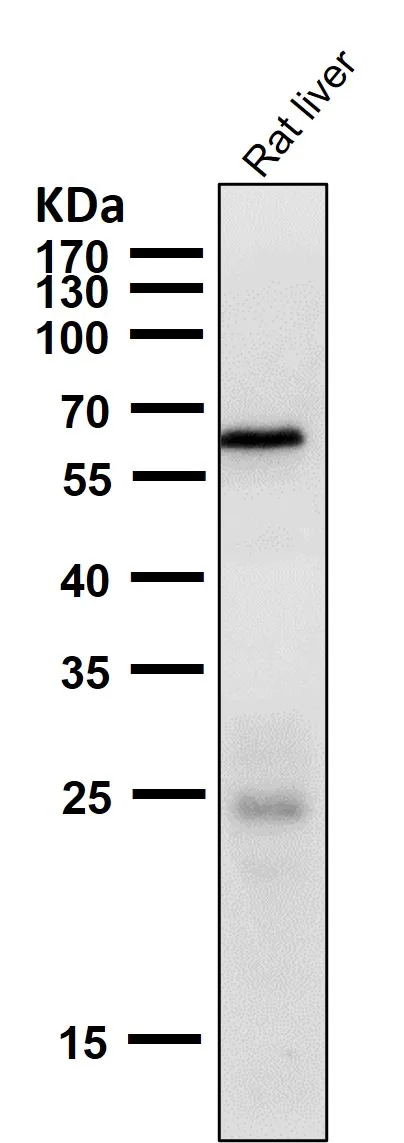
Anti-Phospho-AMPK alfa 2 (S491) PRKAA2 Konijn Monoklonale Antilichaam
Kwaliteit
ISO Gecertificeerd
Levering
24-48 uur
Technische Specificaties
Boster Bio Anti-Phospho-AMPK alpha 2 (S491) PRKAA2 Rabbit Monoclonal Antibody catalog # P01420-1. Tested in WB application. This antibody reacts with Human, Mouse, Rat.
S491
5'-AMP-activated protein kinase catalytic subunit alpha-2; AMPK subunit alpha-2;2.7.11.1 ; Acetyl-CoA carboxylase kinase; ACACA kinase;2.7.11.27 ; Hydroxymethylglutaryl-CoA reductase kinase; HMGCR kinase;2.7.11.31 ; PRKAA2; AMPK, AMPK2
PRKAA2
5563
P54646
• Rabbit
Human, Mouse, Rat
A synthesized peptide derived from human AMPK alpha 2
• Monoclonal
Clone: HFI-16
Isoform TrkB is expressed in the central and peripheral nervous system. In the central nervous system (CNS), expression is observed in the cerebral cortex, hippocampus, thalamus, choroid plexus, granular layer of the cerebellum, brain stem, and spinal cord. In the peripheral nervous system, it is expressed in many cranial ganglia, the ophthalmic nerve, the vestibular system, multiple facial structures, the submaxillary glands, and dorsal root ganglia. Isoform TrkB-T1 is mainly expressed in the brain but also detected in other tissues including pancreas, kidney and heart. Isoform TrkB-T-Shc is predominantly expressed in the brain. .
WB
Cancer, Growth and Development, Metabolism, Metabolism Processes, Neurology Process, Neuroscience, Oncoproteins, Oncoproteins/Suppressors, Pathways and Processes
Affinity-chromatography
0.5mg/ml
Liquid
Catalytic subunit of AMP-activated protein kinase (AMPK), an energy sensor protein kinase that plays a key role in regulating cellular energy metabolism. In response to reduction of intracellular ATP levels, AMPK activates energy-producing pathways and inhibits energy-consuming processes: inhibits protein, carbohydrate and lipid biosynthesis, as well as cell growth and proliferation. AMPK acts via phosphorylation of metabolic enzymes, and by longer-term effects via phosphorylation of transcription regulators. Also acts as a regulator of cellular polarity by remodeling the actin cytoskeleton; probably by inly activating myosin. Regulates lipid synthesis by phosphorylating and inactivating lipid metabolic enzymes such as ACACA, ACACB, GYS1, HMGCR and LIPE; regulates fatty acid and cholesterol synthesis by phosphorylating acetyl-CoA carboxylase (ACACA and ACACB) and hormone-sensitive lipase (LIPE) enzymes, respectively. Regulates insulin-signaling and glycolysis by phosphorylating IRS1, PFKFB2 and PFKFB3. Involved in insulin receptor/INSR internalization (PubMed:25687571) . AMPK stimulates glucose uptake in muscle by increasing the translocation of the glucose transporter SLC2A4/GLUT4 to the plasma membrane, possibly by mediating phosphorylation of TBC1D4/AS160. Regulates transcription and chromatin structure by phosphorylating transcription regulators involved in energy metabolism such as CRTC2/TORC2, FOXO3, histone H2B, HDAC5, MEF2C, MLXIPL/ChREBP, EP300, HNF4A, p53/TP53, SREBF1, SREBF2 and PPARGC1A. Acts as a key regulator of glucose homeostasis in liver by phosphorylating CRTC2/TORC2, leading to CRTC2/TORC2 sequestration in the cytoplasm. In response to stress, phosphorylates 'Ser-36' of histone H2B (H2BS36ph), leading to promote transcription. Acts as a key regulator of cell growth and proliferation by phosphorylating TSC2, RPTOR and ATG1/ULK1: in response to nutrient limitation, negatively regulates the mTORC1 complex by phosphorylating RPTOR component of the mTORC1 complex and by phosphorylating and activating TSC2. In response to nutrient limitation, promotes autophagy by phosphorylating and activating ATG1/ULK1. AMPK also acts as a regulator of circadian rhythm by mediating phosphorylation of CRY1, leading to destabilize it. May regulate the Wnt signaling pathway by phosphorylating CTNNB1, leading to stabilize it. Also phosphorylates CFTR, EEF2K, KLC1, NOS3 and SLC12A1. Plays an important role in the differential regulation of pro-autophagy (composed of PIK3C3, BECN1, PIK3R4 and UVRAG or ATG14) and non-autophagy (composed of PIK3C3, BECN1 and PIK3R4) complexes, in response to glucose starvation. Can inhibit the non-autophagy complex by phosphorylating PIK3C3 and can activate the pro-autophagy complex by phosphorylating BECN1 (By similarity) . .
Store at -20°C for one year. For short term storage and frequent use, store at 4°C for up to one month. Avoid repeated freeze-thaw cycles.
https://www.bosterbio.com/msds?sku=P01420-1
62320 MW
130 kDa
5'-AMP-activated protein kinase catalytic subunit alpha-2
Cytoplasm . Nucleus . In response to stress, recruited by p53/TP53 to specific promoters.
Rabbit IgG
Rabbit IgG in phosphate buffered saline, pH 7.4, 150mM NaCl, 0.02% sodium azide and 50% glycerol, 0.4-0.5mg/ml BSA.
Beschrijving
Boster Bio Anti-Phospho-AMPK alpha 2 (S491) PRKAA2 Rabbit Monoclonal Antibody catalog # P01420-1. Tested in WB application. This antibody reacts with Human, Mou
Specificaties
Recent bekeken producten

Cellubrevin Antibody
MBS9436639-01
0.05 mL
Oxidative Stress Combo Assay Tissue Kit
EA-7008
1 Each
Arachis hypogaea Lectin (PNA) - Biotinylated
21510020-1
5mg
1,4- Dioxane Pure
1041330 500
500 mL
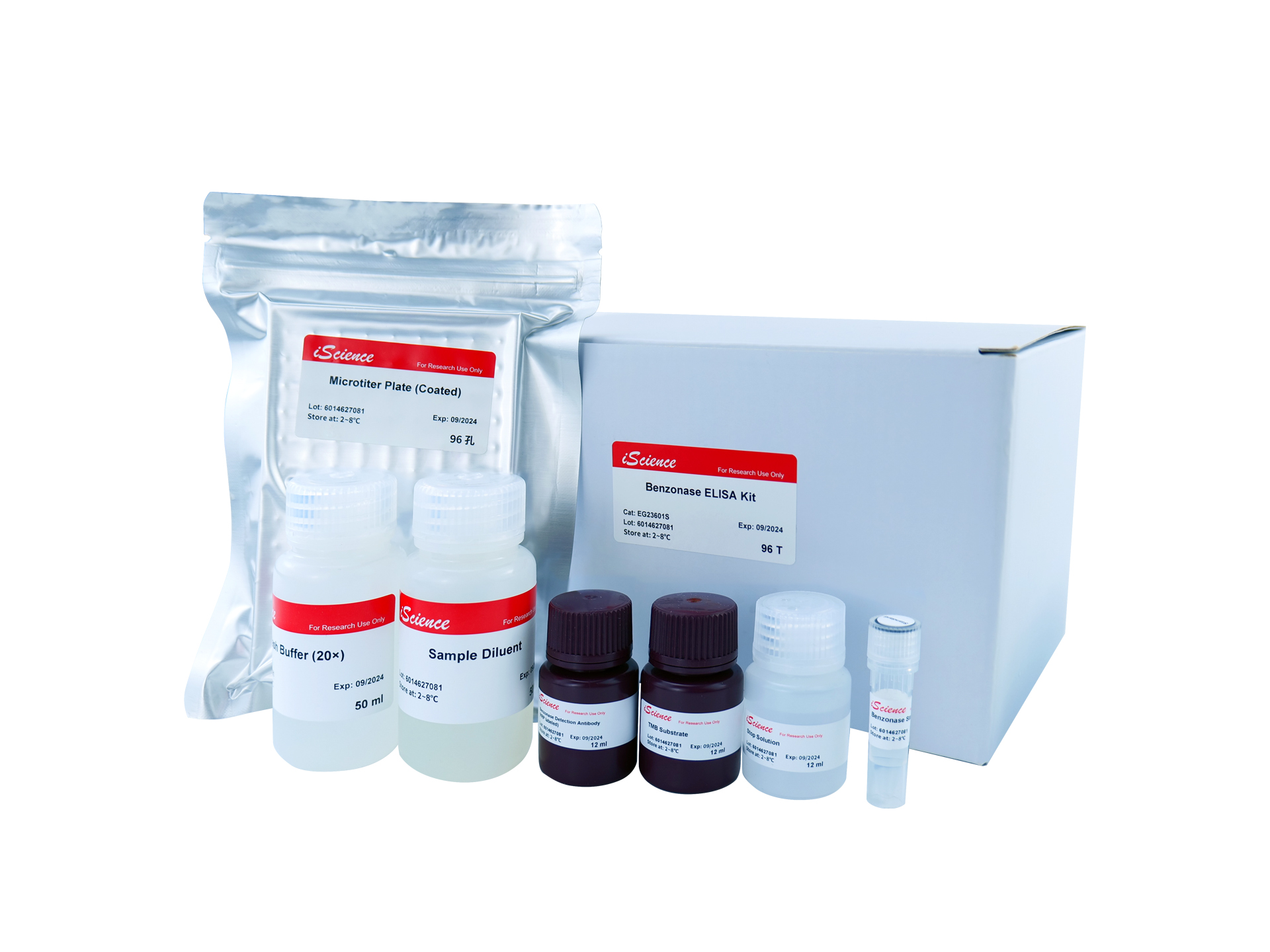
Benzonase ELISA Kit
EG23601S
96 Tests

Not I Restriction Enzyme
B2016623
500 Units
K562-HLA-G0101 Overexpressing Cell Line
RG-1214
5x 10^6
Yeast Poly (A) Polymerase
RNT-006-S
30000 Units
Recent gezochte producten
Cellubrevin Antibody
MBS9436639-01
0.05 mL
Rat Oxidative Stress Primer Library
ROSL-I
1 set
DTNB (Ellman’s) Thiol Oxidative Stress Assay
1021
1 Kit
OSR1 (Oxidative Stress Responsive 1)
MBS616581-01
0.1 mL
Oxidative Stress Combo Assay Cell Kit
EA-7006
1 Each
Oxidative Stress Combo Assay Blood Kit
EA-7007
1 Each
Oxidative Stress Combo Assay Tissue Kit
EA-7008
1 Each
OSR1 (Oxidative Stress Responsive 1)
O8054
100 µL