
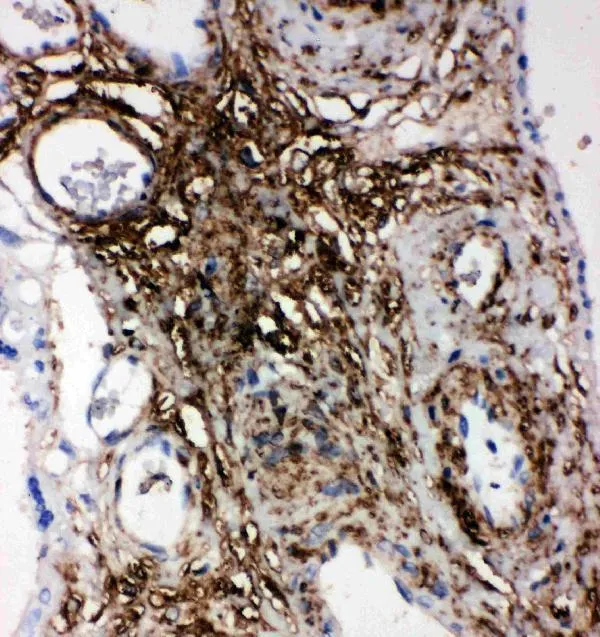
Anti-Phospholipid transfer protein PLTP Antibody Picoband®
Kwaliteit
ISO Gecertificeerd
Levering
24-48 uur
Technische Specificaties
Phospholipid transfer protein (PLTP), also known as lipid transfer protein II is a protein that in humans is encoded by the PLTP gene. This gene is mapped to 20q13.12. The protein encoded by this gene is one of at least two lipid transfer proteins found in human plasma. The encoded protein transfers phospholipids from triglyceride-rich lipoproteins to high density lipoprotein (HDL) . In addition to regulating the size of HDL particles, this protein may be involved in cholesterol metabolism. At least two transcript variants encoding different isoforms have been found for this gene.
Boster Bio Anti-Phospholipid transfer protein PLTP Antibody catalog # PA2228. Tested in IHC, WB applications. This antibody reacts with Human. The brand Picoband indicates this is a premium antibody that guarantees superior quality, high affinity, and strong signals with minimal background in Western blot applications. Only our best-performing antibodies are designated as Picoband, ensuring unmatched performance.
Phospholipid transfer protein; Lipid transfer protein II; PLTP
PLTP
5360
P55058
• Rabbit
Human
No cross-reactivity with other proteins
A synthetic peptide corresponding to a sequence in the middle region of human PLTP.
• Polyclonal
Wide tissue distribution. Placenta > pancreas > lung > kidney > heart > liver > skeletal muscle > brain.
IHC, WB
Atherosclerosis, Cancer, Cancer Metabolism, Cardiovascular, Cholesterol Metabolism, Heart Disease, Lipid and Lipoprotein Metabolism, Lipid Metabolism, Lipids/Lipoproteins, Metabolic Signaling Pathway, Metabolic Signaling Pathways, Metabolism, Metabolism of Lipids and Lipoproteins, Pathways and Processes, Serum Proteins, Signal Transduction
Immunogen affinity purified.
Adding 0.2 ml of distilled water will yield a concentration of 500 μg/ml.
Lyophilized
Add 0.2ml of distilled water will yield a concentration of 500ug/ml.
Facilitates the transfer of a spectrum of different lipid molecules, including diacylglycerol, phosphatidic acid, sphingomyelin, phosphatidylcholine, phosphatidylglycerol, cerebroside and phosphatidyl ethanolamine. Essential for the transfer of excess surface lipids from triglyceride-rich lipoproteins to HDL, thereby facilitating the formation of smaller lipoprotein remnants, contributing to the formation of LDL, and assisting in the maturation of HDL particles. PLTP also plays a key role in the uptake of cholesterol from peripheral cells and tissues that is subsequently transported to the liver for degradation and excretion. Two distinct forms of PLTP exist in plasma: an active form that can transfer PC from phospholipid vesicles to high-density lipoproteins (HDL), and an inactive form that lacks this capability.
1. Jiang, X., Bruce, C., Mar, J., Lin, M., Ji, Y., Francone, O. L., Tall, A. R. Targeted mutation of plasma phospholipid transfer protein gene markedly reduces high-absorbance lipoprotein levels. J. Clin. Invest. 103: 907-914, 1999. 2. Spirin, V., Schmidt, S., Pertsemlidis, A., Cooper, R. S., Cohen, J. C., Sunyaev, S. R. Common single-nucleotide polymorphisms act in concert to affect plasma levels of high-absorbance lipoprotein cholesterol. Am. J. Hum. Genet. 81: 1298-1303, 2007. 3. Teslovich, T. M., Musunuru, K., Smith, A. V., Edmondson, A. C., Stylianou, I. M., Koseki, M., Pirruccello, J. P., Ripatti, S., Chasman, D. I., Willer, C. J., Johansen, C. T., Fouchier, S. W., and 197 others. Biological, clinical and population relevance of 95 loci for blood lipids. Nature 466: 707-713, 2010.
Store at -20°C for one year from date of receipt. After reconstitution, at 4°C for one month. It can also be aliquotted and stored frozen at -20°C for six months. Avoid repeated freeze-thaw cycles.
https://www.bosterbio.com/msds?sku=PA2228
54739 MW
55 kDa
No cross reactivity with other proteins.
Phospholipid transfer protein
Secreted.
Belongs to the BPI/LBP/Plunc superfamily. BPI/LBP family.
Phospholipid transfer protein
Rabbit IgG
Each vial contains 5mg BSA, 0.9mg NaCl, 0.2mg Na2HPO4, 0.05mg Thimerosal, 0.05mg NaN3.
Beschrijving
Boster Bio Anti-Phospholipid transfer protein PLTP Antibody catalog # PA2228. Tested in IHC, WB applications. This antibody reacts with Human. The brand Picoban
Specificaties
Recent bekeken producten

Arachis hypogaea Lectin (PNA) - Biotinylated
21510020-1
5mg
1,4- Dioxane Pure
1041330 500
500 mL
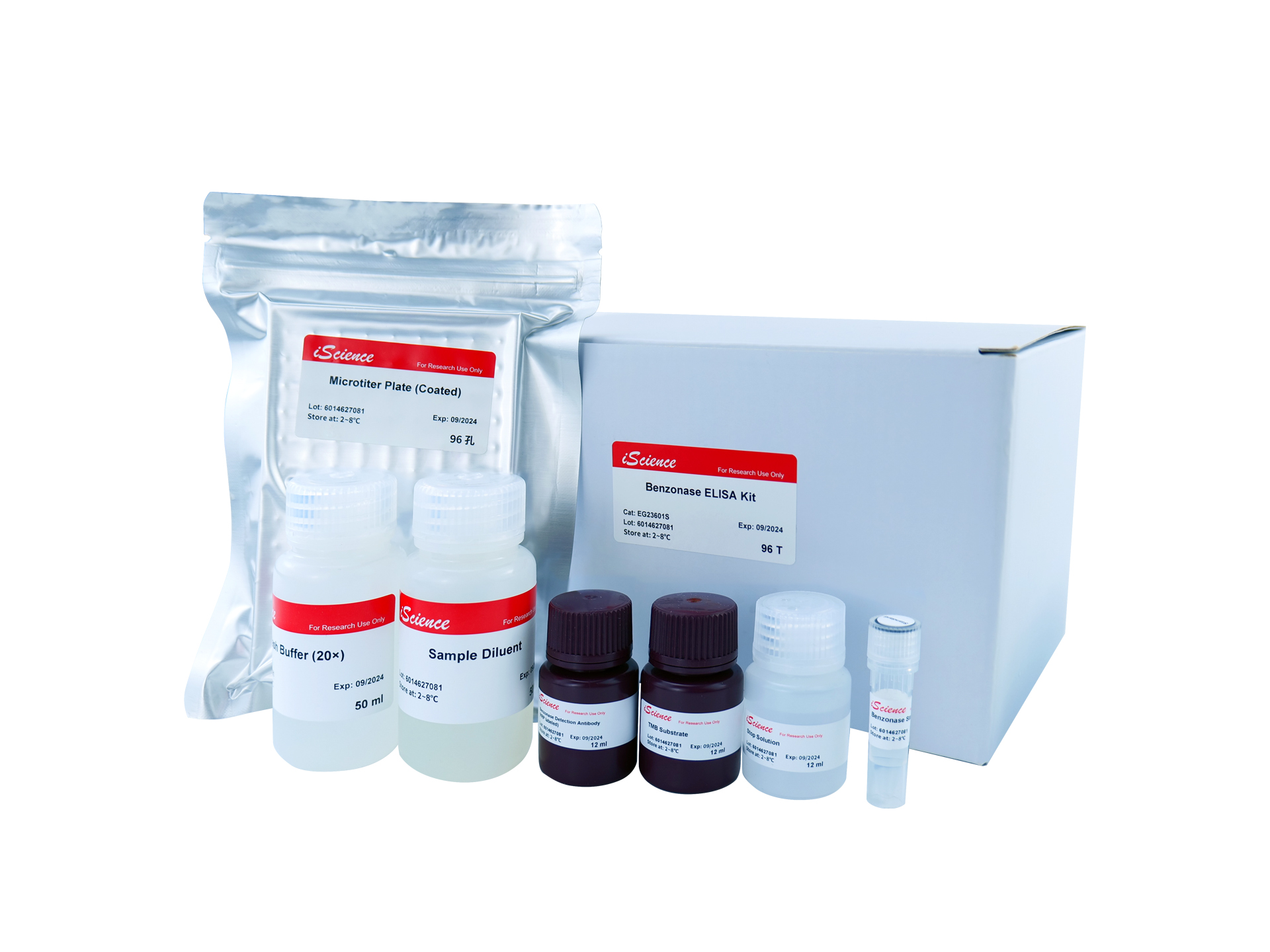
Benzonase ELISA Kit
EG23601S
96 Tests

Not I Restriction Enzyme
B2016623
500 Units
K562-HLA-G0101 Overexpressing Cell Line
RG-1214
5x 10^6
Yeast Poly (A) Polymerase
RNT-006-S
30000 Units
Arachis hypogaea lectin (PNA)
05-0116-10mg
10 mg
Anti-APOE2 mouse monoclonal antibody
TD-AB0132
100 µg