
Anti-PKC alfa/PRKCA Antibody Picoband®
Kwaliteit
ISO Gecertificeerd
Levering
24-48 uur
Technische Specificaties
Protein kinase C (PKC) is the major phorbol ester receptor. Activation of PKC by calcium ions and the second messenger diacylglycerol is though to play a central role in the induction of cellular responses to a variety of ligand-receptor systems and in the regulation of cellular responsiveness to external stimuli. Three of these, termed alpha, beta and gamma, are highly homologous. PRKCA1 is mapped to 17q22-q23.2. PKC-alpha regulates cardiac contractility and propensity toward heart failure.
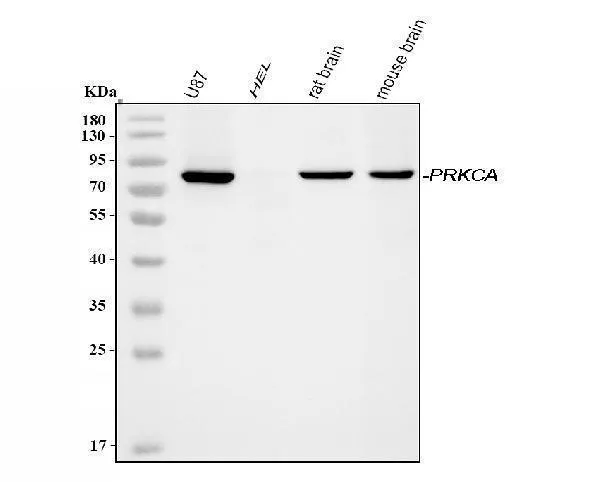
Boster Bio Anti-PKC alpha/PRKCA Antibody catalog # PA1065. Tested in IHC, WB applications. This antibody reacts with Human, Mouse, Rat. The brand Picoband indicates this is a premium antibody that guarantees superior quality, high affinity, and strong signals with minimal background in Western blot applications. Only our best-performing antibodies are designated as Picoband, ensuring unmatched performance.
Protein kinase C alpha type; PKC-A; PKC-alpha;2.7.11.13; PRKCA; PKCA, PRKACA
PRKCA
5578
P17252
• Rabbit
Human, Mouse, Rat
No cross-reactivity with other proteins
A synthetic peptide corresponding to a sequence at the N-terminus of human PRKCA, different from the related rat and mouse sequences by one amino acid.
• Polyclonal
Brain and peripheral tissues.
IHC, WB
Cancer, Cardiovascular, Hypertrophy, Protein Phosphorylation, Ser/Thr Kinases, Serine/Threonine Kinases, Signal Transduction
Immunogen affinity purified.
Adding 0.2 ml of distilled water will yield a concentration of 500 μg/ml.
Lyophilized
Add 0.2ml of distilled water will yield a concentration of 500ug/ml.
Calcium-activated, phospholipid- and diacylglycerol (DAG) -dependent serine/threonine-protein kinase that is involved in positive and negative regulation of cell proliferation, apoptosis, differentiation, migration and adhesion, tumorigenesis, cardiac hypertrophy, angiogenesis, platelet function and inflammation, by ly phosphorylating targets such as RAF1, BCL2, CSPG4, TNNT2/CTNT, or activating signaling cascade involving MAPK1/3 (ERK1/2) and RAP1GAP. Involved in cell proliferation and cell growth arrest by positive and negative regulation of the cell cycle. Can promote cell growth by phosphorylating and activating RAF1, which mediates the activation of the MAPK/ERK signaling cascade, and/or by up-regulating CDKN1A, which facilitates active cyclin-dependent kinase (CDK) complex formation in glioma cells. In intestinal cells stimulated by the phorbol ester PMA, can trigger a cell cycle arrest program which is associated with the accumulation of the hyper-phosphorylated growth-suppressive form of RB1 and induction of the CDK inhibitors CDKN1A and CDKN1B. Exhibits anti-apoptotic function in glioma cells and protects them from apoptosis by suppressing the p53/TP53-mediated activation of IGFBP3, and in leukemia cells mediates anti-apoptotic action by phosphorylating BCL2. During macrophage differentiation induced by macrophage colony-stimulating factor (CSF1), is translocated to the nucleus and is associated with macrophage development. After wounding, translocates from focal contacts to lamellipodia and participates in the modulation of desmosomal adhesion. Plays a role in cell motility by phosphorylating CSPG4, which induces association of CSPG4 with extensive lamellipodia at the cell periphery and polarization of the cell accompanied by increases in cell motility. Is highly expressed in a number of cancer cells where it can act as a tumor promoter and is implicated in malignant phenotypes of several tumors such as gliomas and breast cancers. Negatively regulates myocardial contractility and positively regulates angiogenesis, platelet aggregation and thrombus formation in arteries. Mediates hypertrophic growth of neonatal cardiomyocytes, in part through a MAPK1/3 (ERK1/2) - dependent signaling pathway, and upon PMA treatment, is required to induce cardiomyocyte hypertrophy up to heart failure and death, by increasing protein synthesis, protein-DNA ratio and cell surface area. Regulates cardiomyocyte function by phosphorylating cardiac troponin T (TNNT2/CTNT), which induces significant reduction in actomyosin ATPase activity, myofilament calcium sensitivity and myocardial contractility. In angiogenesis, is required for full endothelial cell migration, adhesion to vitronectin (VTN), and vascular endothelial growth factor A (VEGFA) -dependent regulation of kinase activation and vascular tube formation. Involved in the stabilization of VEGFA mRNA at post-transcriptional level and mediates VEGFA-induced cell proliferation. In the regulation of calcium-induced platelet aggregation, mediates signals from the CD36/GP4 receptor for granule release, and activates the integrin heterodimer ITGA2B- ITGB3 through the RAP1GAP pathway for adhesion. During response to lipopolysaccharides (LPS), may regulate selective LPS-induced macrophage functions involved in host defense and inflammation. But in some inflammatory responses, may negatively regulate NF- kappa-B-induced genes, through IL1A-dependent induction of NF- kappa-B inhibitor alpha (NFKBIA/IKBA) . Upon stimulation with 12-O- tetradecanoylphorbol-13-acetate (TPA), phosphorylates EIF4G1, which modulates EIF4G1 binding to MKNK1 and may be involved in the regulation of EIF4E phosphorylation. Phosphorylates KIT, leading to inhibition of KIT activity. Phosphorylates ATF2 which promotes cooperation between ATF2 and JUN, activating transcription. .
1. Braz, J. C.; Gregory, K.; Pathak, A.; Zhao, W.; Sahin, B.; Klevitsky, R.; Kimball, T. F.; Lorenz, J. N.; Nairn, A. C.; Liggett, S. B.; Bodi, I.; Wang, S.; and 9 others : PKC-alpha regulates cardiac contractility and propensity toward heart failure. Nature Med. 10: 248-254, 2004. 2. Latos-Bielenska, A.; Klett, C.; Just, W.; Hameister, H. : Refinement of localization of the human genes for myeloperoxidase (MPO), protein kinase C, alpha polypeptide, PRKCA, and the DNA fragment D17S21 on chromosome 17q. Hereditas 115: 69-72, 1991.
Store at -20°C for one year from date of receipt. After reconstitution, at 4°C for one month. It can also be aliquotted and stored frozen at -20°C for six months. Avoid repeated freeze-thaw cycles.
https://www.bosterbio.com/msds?sku=PA1065
76750 MW
77 kDa
No cross reactivity with other proteins.
Protein kinase C alpha type
Cytoplasm. Cell membrane; Peripheral membrane protein. Mitochondrion membrane ; Peripheral membrane protein . Nucleus.
Belongs to the protein kinase superfamily. AGC Ser/Thr protein kinase family. PKC subfamily.
Protein kinase C alpha type
Rabbit IgG
Each vial contains 5mg BSA, 0.9mg NaCl, 0.2mg Na2HPO4, 0.05mg Thimerosal, 0.05mg NaN3.
Beschrijving
Boster Bio Anti-PKC alpha/PRKCA Antibody catalog # PA1065. Tested in IHC, WB applications. This antibody reacts with Human, Mouse, Rat. The brand Picoband indic
Specificaties
Recent bekeken producten

Anti- Protein A Antibody
GWB-E66F30
1 mL
Recombinant TAFV GP1 Protein, C-Fc
EVV03609
100 μg
Gabbr1 Mouse Monoclonal Antibody [Clone ID: S93A-49]
TA326530
100 µg
BSA-Myc/DDK Control Protein
AR100025
50 µL
NH-6
ABC-TC0826
1 Vial
Anti-TAT (Thrombin-antithrombin) Antibody
ABS 014-22-1
1000 µL
Anti-APOE2 mouse monoclonal antibody
TD-AB0132
100 µg
CD35 (CR1) mouse monoclonal antibody, clone J3D3, Azide Free
BM2364
0.2 mg