
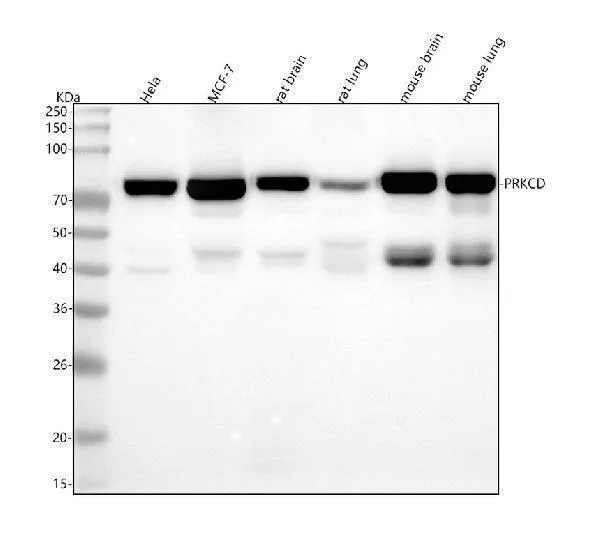
Anti-PKC delta PRKCD Konijn Monoklonale Antilichaam
Kwaliteit
ISO Gecertificeerd
Levering
24-48 uur
Technische Specificaties
Boster Bio Anti-PKC delta PRKCD Rabbit Monoclonal Antibody catalog # M00822. Tested in WB, IHC, ICC/IF applications. This antibody reacts with Human, Mouse, Rat.
Protein kinase C delta type;2.7.11.13; Tyrosine-protein kinase PRKCD;2.7.10.2; nPKC-delta; Protein kinase C delta type regulatory subunit; Protein kinase C delta type catalytic subunit; Sphingosine-dependent protein kinase-1; SDK1; PRKCD
PRKCD
5580
Q05655
• Rabbit
Human, Mouse, Rat
A synthesized peptide derived from human PKC delta
• Monoclonal
Clone: IHD-16
Ubiquitous. .
WB, IHC, ICC, IF
Cancer, Oncoproteins/Suppressors, Tumor Suppressors
Affinity-chromatography
0.5mg/ml
Liquid
Calcium-independent, phospholipid- and diacylglycerol (DAG) -dependent serine/threonine-protein kinase that plays contrasting roles in cell death and cell survival by functioning as a pro-apoptotic protein during DNA damage-induced apoptosis, but acting as an anti-apoptotic protein during cytokine receptor- initiated cell death, is involved in tumor suppression as well as survival of several cancers, is required for oxygen radical production by NADPH oxidase and acts as positive or negative regulator in platelet functional responses. Negatively regulates B cell proliferation and also has an important function in self- antigen induced B cell tolerance induction. Upon DNA damage, activates the promoter of the death-promoting transcription factor BCLAF1/Btf to trigger BCLAF1-mediated p53/TP53 gene transcription and apoptosis. In response to oxidative stress, interact with and activate CHUK/IKKA in the nucleus, causing the phosphorylation of p53/TP53. In the case of ER stress or DNA damage-induced apoptosis, can form a complex with the tyrosine-protein kinase ABL1 which trigger apoptosis independently of p53/TP53. In cytosol can trigger apoptosis by activating MAPK11 or MAPK14, inhibiting AKT1 and decreasing the level of X-linked inhibitor of apoptosis protein (XIAP), whereas in nucleus induces apoptosis via the activation of MAPK8 or MAPK9. Upon ionizing radiation treatment, is required for the activation of the apoptosis regulators BAX and BAK, which trigger the mitochondrial cell death pathway. Can phosphorylate MCL1 and target it for degradation which is sufficient to trigger for BAX activation and apoptosis. Is required for the control of cell cycle progression both at G1/S and G2/M phases. Mediates phorbol 12-myristate 13-acetate (PMA) - induced inhibition of cell cycle progression at G1/S phase by up- regulating the CDK inhibitor CDKN1A/p21 and inhibiting the cyclin CCNA2 promoter activity. In response to UV irradiation can phosphorylate CDK1, which is important for the G2/M DNA damage checkpoint activation. Can protect glioma cells from the apoptosis induced by TNFSF10/TRAIL, probably by inducing increased phosphorylation and subsequent activation of AKT1. Is highly expressed in a number of cancer cells and promotes cell survival and resistance against chemotherapeutic drugs by inducing cyclin D1 (CCND1) and hyperphosphorylation of RB1, and via several pro- survival pathways, including NF-kappa-B, AKT1 and MAPK1/3 (ERK1/2) . Can also act as tumor suppressor upon mitogenic stimulation with PMA or TPA. In N-formyl-methionyl-leucyl- phenylalanine (fMLP) -treated cells, is required for NCF1 (p47- phox) phosphorylation and activation of NADPH oxidase activity, and regulates TNF-elicited superoxide anion production in neutrophils, by phosphorylation and activation of NCF1 or inly through MAPK1/3 (ERK1/2) signaling pathways. May also play a role in the regulation of NADPH oxidase activity in eosinophil after stimulation with IL5, leukotriene B4 or PMA. In collagen-induced platelet aggregation, acts a negative regulator of filopodia formation and actin polymerization by interacting with and negatively regulating VASP phosphorylation. Downstream of PAR1, PAR4 and CD36/GP4 receptors, regulates differentially platelet dense granule secretion; acts as a positive regulator in PAR-mediated granule secretion, whereas it negatively regulates CD36/GP4-mediated granule release. Phosphorylates MUC1 in the C- terminal and regulates the interaction between MUC1 and beta- catenin. The catalytic subunit phosphorylates 14-3-3 proteins (YWHAB, YWHAZ and YWHAH) in a sphingosine-dependent fashion (By similarity) . .
Store at -20°C for one year. For short term storage and frequent use, store at 4°C for up to one month. Avoid repeated freeze-thaw cycles.
https://www.bosterbio.com/msds?sku=M00822
77505 MW
78 kDa
Protein kinase C delta type
Cytoplasm. Cytoplasm, perinuclear region. Nucleus. Endoplasmic reticulum. Mitochondrion. Cell membrane; Peripheral membrane protein.
Glycogen synthase kinase-3 beta (gsk3b)
Rabbit IgG
Rabbit IgG in phosphate buffered saline, pH 7.4, 150mM NaCl, 0.02% sodium azide and 50% glycerol, 0.4-0.5mg/ml BSA.
Beschrijving
Boster Bio Anti-PKC delta PRKCD Rabbit Monoclonal Antibody catalog # M00822. Tested in WB, IHC, ICC/IF applications. This antibody reacts with Human, Mouse, Rat
Specificaties
Recent bekeken producten

Cellubrevin Antibody
MBS9436639-01
0.05 mL
Oxidative Stress Combo Assay Tissue Kit
EA-7008
1 Each
Arachis hypogaea Lectin (PNA) - Biotinylated
21510020-1
5mg
1,4- Dioxane Pure
1041330 500
500 mL
Benzonase ELISA Kit
EG23601S
96 Tests

Not I Restriction Enzyme
B2016623
500 Units
K562-HLA-G0101 Overexpressing Cell Line
RG-1214
5x 10^6
Yeast Poly (A) Polymerase
RNT-006-S
30000 Units
Recent gezochte producten
Cellubrevin Antibody
MBS9436639-01
0.05 mL
Rat Oxidative Stress Primer Library
ROSL-I
1 set
DTNB (Ellman’s) Thiol Oxidative Stress Assay
1021
1 Kit
OSR1 (Oxidative Stress Responsive 1)
MBS616581-01
0.1 mL
Oxidative Stress Combo Assay Cell Kit
EA-7006
1 Each
Oxidative Stress Combo Assay Blood Kit
EA-7007
1 Each
Oxidative Stress Combo Assay Tissue Kit
EA-7008
1 Each
OSR1 (Oxidative Stress Responsive 1)
O8054
100 µL