
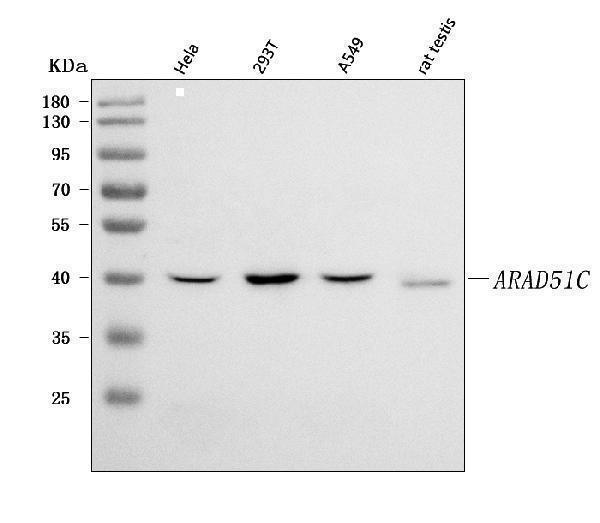
Anti-RAD51C Antibody Picoband®
Kwaliteit
ISO Gecertificeerd
Levering
24-48 uur
Technische Specificaties
RAD51 homolog C (S. cerevisiae), also known as RAD51C, is a protein which in humans is encoded by the RAD51C gene. This gene is a member of the RAD51 family of related genes, which encode strand-transfer proteins thought to be involved in recombinational repair of damaged DNA and in meiotic recombination. Ana this gene product interacts with two other DNA repair proteins, encoded by RAD51B and XRCC3, but not with itself. The protein copurifies with XRCC3 protein in a complex, reflecting their endogenous association and suggesting a cooperative role during recombinational repair. This gene is one of four localized to a region of chromosome 17q23 where amplification occurs frequently in breast tumors. Overexpression of the four genes during amplification has been observed and suggests a possible role in tumor progression. Alternative splicing has been observed for this gene and two variants encoding different isoforms have been identified.
Boster Bio Anti-RAD51C Antibody Picoband® catalog # A01837-1. Tested in ELISA, Flow Cytometry, IHC, WB applications. This antibody reacts with Human, Rat. The brand Picoband indicates this is a premium antibody that guarantees superior quality, high affinity, and strong signals with minimal background in Western blot applications. Only our best-performing antibodies are designated as Picoband, ensuring unmatched performance.
Period circadian protein homolog 3; hPER3; Cell growth-inhibiting gene 13 protein; Circadian clock protein PERIOD 3; PER3; GIG13
RAD51C
5889
O43502
• Rabbit
Human, Rat
No cross-reactivity with other proteins.
E.coli-derived human RAD51C recombinant protein (Position: Q11-K342) .
• Polyclonal
WB, IHC, Flow Cytometry, ELISA
Cardiogenesis, Cardiovascular, Epigenetics and Nuclear Signaling, Transcription, Transcription Factors, Transcription Factors/Regulators
Immunogen affinity purified.
Adding 0.2 ml of distilled water will yield a concentration of 500 μg/ml.
Lyophilized
Adding 0.2 ml of distilled water will yield a concentration of 500 μg/ml.
Originally described as a core component of the circadian clock. The circadian clock, an internal time-keeping system, regulates various physiological processes through the generation of approximately 24 hour circadian rhythms in gene expression, which are translated into rhythms in metabolism and behavior. It is derived from the Latin roots 'circa' (about) and 'diem' (day) and acts as an important regulator of a wide array of physiological functions including metabolism, sleep, body temperature, blood pressure, endocrine, immune, cardiovascular, and renal function. Consists of two major components: the central clock, residing in the suprachiasmatic nucleus (SCN) of the brain, and the peripheral clocks that are present in nearly every tissue and organ system. Both the central and peripheral clocks can be reset by environmental cues, also known as Zeitgebers (German for 'timegivers') . The predominant Zeitgeber for the central clock is light, which is sensed by retina and signals ly to the SCN. The central clock entrains the peripheral clocks through neuronal and hormonal signals, body temperature and feeding-related cues, aligning all clocks with the external light/dark cycle. Circadian rhythms allow an organism to achieve temporal homeostasis with its environment at the molecular level by regulating gene expression to create a peak of protein expression once every 24 hours to control when a particular physiological process is most active with respect to the solar day. Transcription and translation of core clock components (CLOCK, NPAS2, ARNTL/BMAL1, ARNTL2/BMAL2, PER1, PER2, PER3, CRY1 and CRY2) plays a critical role in rhythm generation, whereas delays imposed by post-translational modifications (PTMs) are important for determining the period (tau) of the rhythms (tau refers to the period of a rhythm and is the length, in time, of one complete cycle) . A diurnal rhythm is synchronized with the day/night cycle, while the ultradian and infradian rhythms have a period shorter and longer than 24 hours, respectively. Disruptions in the circadian rhythms contribute to the pathology of cardiovascular diseases, cancer, metabolic syndromes and aging. A transcription/translation feedback loop (TTFL) forms the core of the molecular circadian clock mechanism. Transcription factors, CLOCK or NPAS2 and ARNTL/BMAL1 or ARNTL2/BMAL2, form the positive limb of the feedback loop, act in the form of a heterodimer and activate the transcription of core clock genes and clock-controlled genes (involved in key metabolic processes), harboring E-box elements (5'-CACGTG-3') within their promoters. The core clock genes: PER1/2/3 and CRY1/2 which are transcriptional repressors form the negative limb of the feedback loop and interact with the CLOCK
1. Entrez Gene: RAD51C RAD51 homolog C (S. cerevisiae) . 2. Dosanjh MK, Collins DW, Fan W, Lennon GG, Albala JS, Shen Z, Schild D (March 1998) . Isolation and characterization of RAD51C, a new human member of the RAD51 family of related genes. Nucleic Acids Res. 26 (5) : 1179–84.
At -20°C for one year from date of receipt. After reconstitution, at 4°C for one month. It can also be aliquotted and stored frozen at -20°C for six months. Avoid repeated freezing and thawing.
https://www.bosterbio.com/msds?sku=A01837-1
42 kDa
6
Period circadian clock 3
Cytoplasm.
Rabbit IgG
Each vial contains 4 mg Trehalose, 0.9 mg NaCl, 0.2 mg Na2HPO4.
Beschrijving
Boster Bio Anti-RAD51C Antibody Picoband® catalog # A01837-1. Tested in ELISA, Flow Cytometry, IHC, WB applications. This antibody reacts with Human, Rat. T
Specificaties
Recent bekeken producten

Arachis hypogaea Lectin (PNA) - Biotinylated
21510020-1
5mg
1,4- Dioxane Pure
1041330 500
500 mL
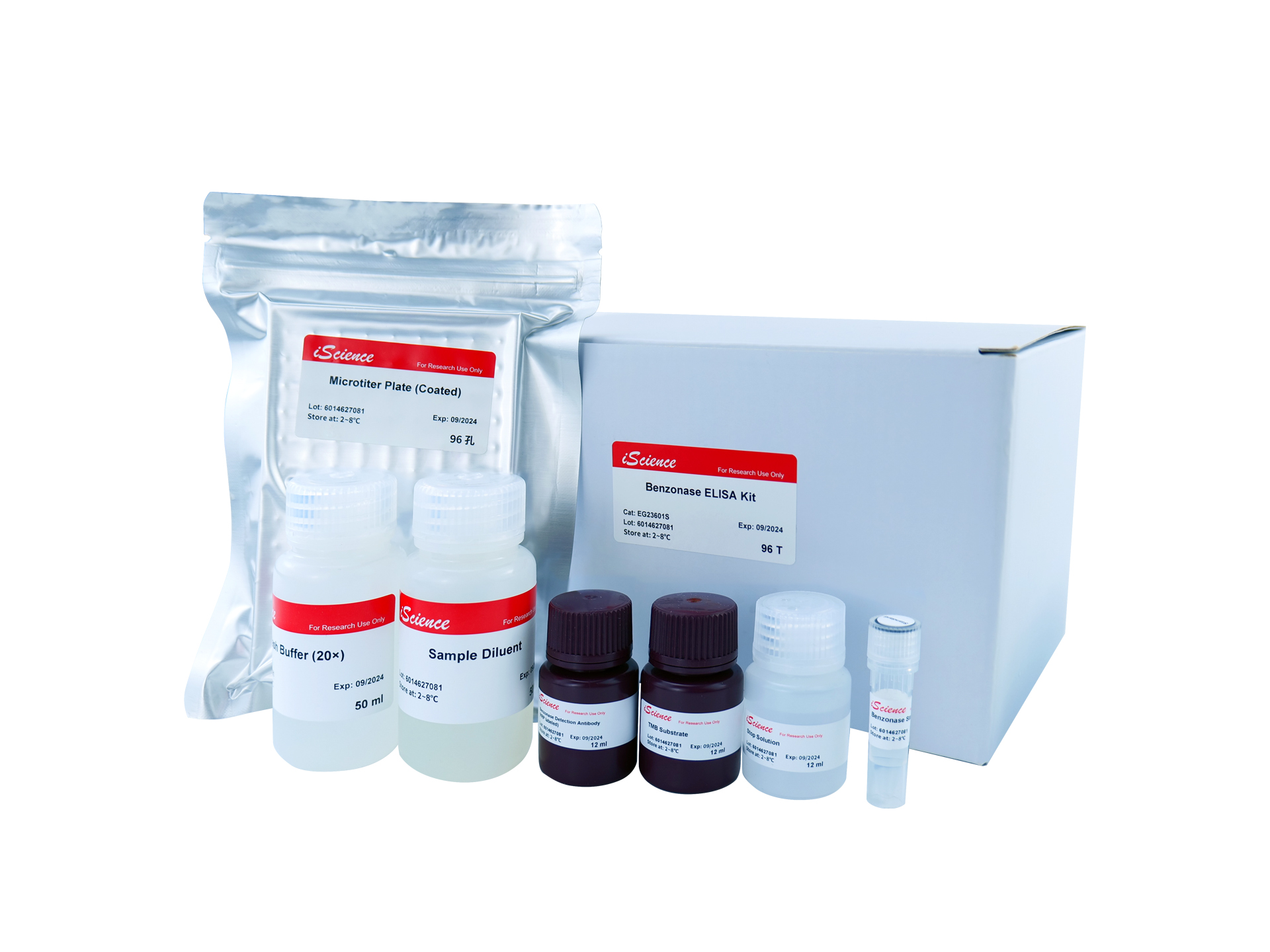
Benzonase ELISA Kit
EG23601S
96 Tests

Not I Restriction Enzyme
B2016623
500 Units
K562-HLA-G0101 Overexpressing Cell Line
RG-1214
5x 10^6
Yeast Poly (A) Polymerase
RNT-006-S
30000 Units
Arachis hypogaea lectin (PNA)
05-0116-10mg
10 mg
Anti-APOE2 mouse monoclonal antibody
TD-AB0132
100 µg