
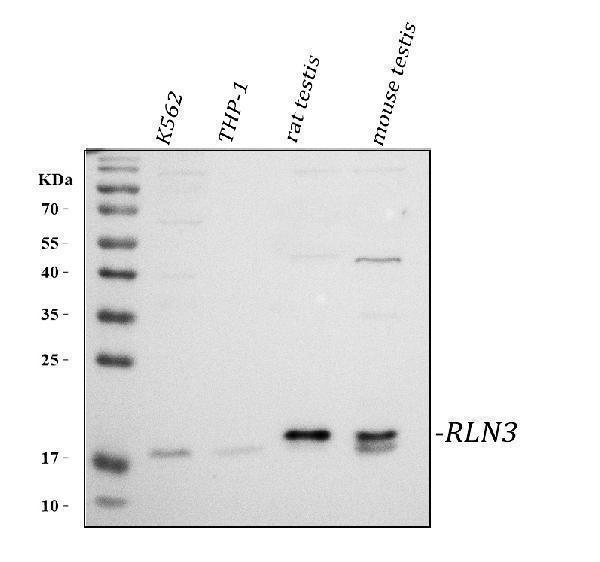
Anti-RLN3 Antibody Picoband®
Kwaliteit
ISO Gecertificeerd
Levering
24-48 uur
Technische Specificaties
This gene encodes a member of the relaxin family of insulin-like hormones that is expressed predominantly in the brain and plays a role in physiological processes such as stress, memory and appetite regulation. The encoded protein is a precursor that is proteolytically processed to generate a heterodimeric mature form consisting A and B chains interlinked by disulfide bonds. Alternative splicing results in multiple transcript variants encoding different isoforms.
Boster Bio Anti-RLN3 Antibody Picoband® catalog # A05495-2. Tested in ELISA, Flow Cytometry, WB applications. This antibody reacts with Human, Mouse, Rat. The brand Picoband indicates this is a premium antibody that guarantees superior quality, high affinity, and strong signals with minimal background in Western blot applications. Only our best-performing antibodies are designated as Picoband, ensuring unmatched performance.
Atypical chemokine receptor 2; C-C chemokine receptor D6; Chemokine receptor CCR-10; Chemokine receptor CCR-9; Chemokine-binding protein 2; Chemokine-binding protein D6; ACKR2; CCBP2; CCR10; CMKBR9; D6
RLN3
117579
Q8WXF3
• Rabbit
Human, Mouse, Rat
No cross-reactivity with other proteins.
E.coli-derived human RLN3 recombinant protein (Position: R26-C142) .
• Polyclonal
Found in endothelial cells lining afferent lymphatics in dermis and lymph nodes. Also found in lymph nodes subcapsular and medullary sinuses, tonsillar lymphatic sinuses and lymphatics in mucosa and submucosa of small and large intestine and appendix. Also found in some malignant vascular tumors. Expressed at high levels in Kaposi sarcoma-related pathologies. Expressed on apoptotic neutrophils (at protein level) . Expressed primarily in placenta and fetal liver, and found at very low levels in the lung and lymph node.
WB, Flow Cytometry, ELISA
Chemokines, Immunology, Innate Immunity
Immunogen affinity purified.
Adding 0.2 ml of distilled water will yield a concentration of 500 μg/ml.
Lyophilized
Adding 0.2 ml of distilled water will yield a concentration of 500 μg/ml.
Atypical chemokine receptor that controls chemokine levels and localization via high-affinity chemokine binding that is uncoupled from classic ligand-driven signal transduction cascades, resulting instead in chemokine sequestration, degradation, or transcytosis. Also known as interceptor (internalizing receptor) or chemokine-scavenging receptor or chemokine decoy receptor. Acts as a receptor for chemokines including CCL2, CCL3, CCL3L1, CCL4, CCL5, CCL7, CCL8, CCL11, CCL13, CCL17, CCL22, CCL23, CCL24, SCYA2/MCP-1, SCY3/MIP-1-alpha, SCYA5/RANTES and SCYA7/MCP-3. Upon active ligand stimulation, activates a beta-arrestin 1 (ARRB1) -dependent, G protein-independent signaling pathway that results in the phosphorylation of the actin-binding protein cofilin (CFL1) through a RAC1-PAK1-LIMK1 signaling pathway. Activation of this pathway results in up-regulation of ACKR2 from endosomal compartment to cell membrane, increasing its efficiency in chemokine uptake and degradation. By scavenging chemokines in tissues, on the surfaces of lymphatic vessels, and in placenta, plays an essential role in the resolution (termination) of the inflammatory response and in the regulation of adaptive immune responses. Plays a major role in the immune silencing of macrophages during the resolution of inflammation. Acts as a regulator of inflammatory leukocyte interactions with lymphatic endothelial cells (LECs) and is required for immature/mature dendritic cells discrimination by LECs.
1. Bathgate, R. A. D., Samuel, C. S., Burazin, T. C. D., Layfield, S., Claasz, A. A., Reytomas, I. G. T., Dawson, N. F., Zhao, C., Bond, C., Summers, R. J., Parry, L. J., Wade, J. D., Tregear, G. W. Human relaxin gene 3 (H3) and the equivalent mouse relaxin (M3) gene: novel members of the relaxin peptide family. J. Biol. Chem. 277: 1148-1157, 2002. 2. Liu, C., Eriste, E., Sutton, S., Chen, J., Roland, B., Kuei, C., Farmer, N., Jornvall, H., Sillard, R., Lovenberg, T. W. Identification of relaxin-3/INSL7 as an endogenous ligand for the orphan G-protein-coupled receptor GPCR135. J. Biol. Chem. 278: 50754-50764, 2003.
At -20°C for one year from date of receipt. After reconstitution, at 4°C for one month. It can also be aliquotted and stored frozen at -20°C for six months. Avoid repeated freezing and thawing.
https://www.bosterbio.com/msds?sku=A05495-2
48608 MW
18-19 kDa
6
Atypical chemokine receptor 2
Cell membrane. Multi-pass membrane protein. Early endosome. Recycling endosome
Serine protease HTRA3
Rabbit IgG
Each vial contains 4 mg Trehalose, 0.9 mg NaCl, 0.2 mg Na2HPO4.
Beschrijving
Boster Bio Anti-RLN3 Antibody Picoband® catalog # A05495-2. Tested in ELISA, Flow Cytometry, WB applications. This antibody reacts with Human, Mouse, Rat. T
Specificaties
Recent bekeken producten

Arachis hypogaea Lectin (PNA) - Biotinylated
21510020-1
5mg
1,4- Dioxane Pure
1041330 500
500 mL
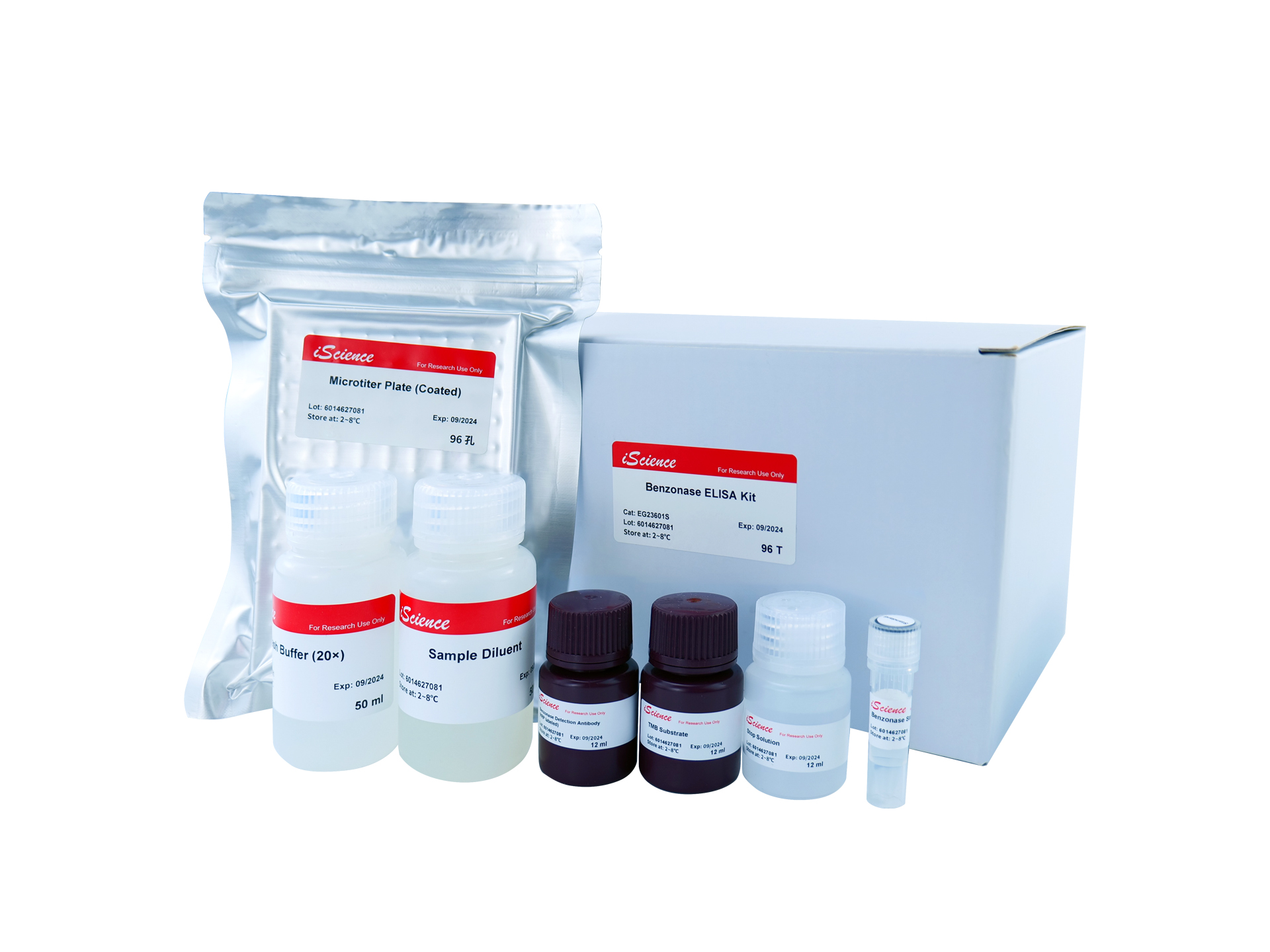
Benzonase ELISA Kit
EG23601S
96 Tests

Not I Restriction Enzyme
B2016623
500 Units
K562-HLA-G0101 Overexpressing Cell Line
RG-1214
5x 10^6
Yeast Poly (A) Polymerase
RNT-006-S
30000 Units
Arachis hypogaea lectin (PNA)
05-0116-10mg
10 mg
Anti-APOE2 mouse monoclonal antibody
TD-AB0132
100 µg