
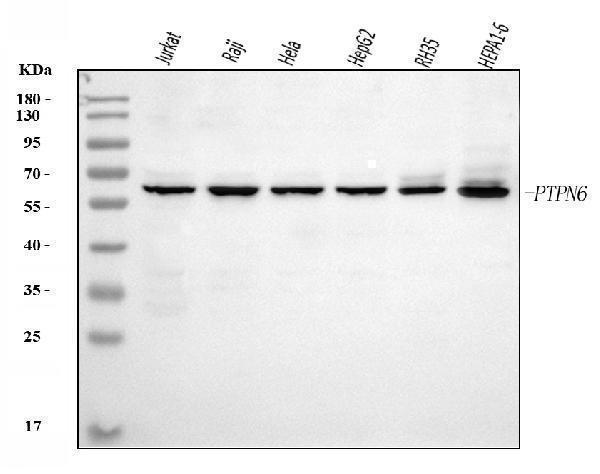
Anti-SHP1/PTPN6 Antibody Picoband® (monoklonale, 8H11B10)
Kwaliteit
ISO Gecertificeerd
Levering
24-48 uur
Technische Specificaties
Tyrosine-protein phosphatase non-receptor type 6, also known as Src homology region 2 domain-containing phosphatase-1 (SHP-1), is an enzyme that in humans is encoded by the PTPN6 gene. The protein encoded by this gene is a member of the protein tyrosine phosphatase (PTP) family. PTPs are known to be signaling molecules that regulate a variety of cellular processes including cell growth, differentiation, mitotic cycle, and oncogenic transformation. N-terminal part of this PTP contains two tandem Src homolog (SH2) domains, which act as protein phospho-tyrosine binding domains, and mediate the interaction of this PTP with its substrates. This PTP is expressed primarily in hematopoietic cells, and functions as an important regulator of multiple signaling pathways in hematopoietic cells. This PTP has been shown to interact with, and dephosphorylate a wide spectrum of phospho-proteins involved in hematopoietic cell signaling. Multiple alternatively spliced variants of this gene, which encode distinct isoforms, have been reported.
Boster Bio Anti-SHP1/PTPN6 Antibody Picoband® (monoclonal, 8H11B10) catalog # M00938-2. Tested in Flow Cytometry, IF, IHC, ICC, WB applications. This antibody reacts with Human, Mouse, Rat. The brand Picoband indicates this is a premium antibody that guarantees superior quality, high affinity, and strong signals with minimal background in Western blot applications. Only our best-performing antibodies are designated as Picoband, ensuring unmatched performance.
CD59 glycoprotein: 1F5 antigen; 20 kDa homologous restriction factor; HRF-20; HRF20; MAC-inhibitory protein; MAC-IP; MEM43 antigen; Membrane attack complex inhibition factor; MACIF; Membrane inhibitor of reactive lysis; MIRL; Protectin; CD59; MIC11; MIN1; MIN2; MIN3; MSK21
PTPN6
5777
P29350
• Mouse
Human, Mouse, Rat
No cross-reactivity with other proteins.
E.coli-derived human SHP1/PTPN6 recombinant protein (Position: E67-K572) .
• Monoclonal
Clone: 8H11B10
Ubiquitous.
Flow Cytometry, IF, IHC, ICC, WB
Apoptosis, Cancer, Cardiovascular, G Protein Signaling, Heterotrimeric G Proteins, Neural Signal Transduction, Neurology Process, Neuroscience, Nucleotide Messenger, Second Messenger, Signal Transduction, Signaling Pathway, Small G Proteins
Immunogen affinity purified.
Adding 0.2 ml of distilled water will yield a concentration of 500 μg/ml.
Lyophilized
Adding 0.2 ml of distilled water will yield a concentration of 500 μg/ml.
RNA-dependent helicase and ATPase required for nonsense-mediated decay (NMD) of mRNAs containing premature stop codons. Is recruited to mRNAs upon translation termination and undergoes a cycle of phosphorylation and dephosphorylation; its phosphorylation appears to be a key step in NMD. Recruited by release factors to stalled ribosomes together with the SMG1C protein kinase complex to form the transient SURF (SMG1-UPF1-eRF1-eRF3) complex. In EJC-dependent NMD, the SURF complex associates with the exon junction complex (EJC) (located 50-55 or more nucleotides downstream from the termination codon) through UPF2 and allows the formation of an UPF1-UPF2-UPF3 surveillance complex which is believed to activate NMD. Phosphorylated UPF1 is recognized by EST1B/SMG5, SMG6 and SMG7 which are thought to provide a link to the mRNA degradation machinery involving exonucleolytic and endonucleolytic pathways, and to serve as adapters to protein phosphatase 2A (PP2A), thereby triggering UPF1 dephosphorylation and allowing the recycling of NMD factors. UPF1 can also activate NMD without UPF2 or UPF3, and in the absence of the NMD-enhancing downstream EJC indicative for alternative NMD pathways. Plays a role in replication-dependent histone mRNA degradation at the end of phase S; the function is independent of UPF2. For the recognition of premature termination codons (PTC) and initiation of NMD a competitive interaction between UPF1 and PABPC1 with the ribosome-bound release factors is proposed. The ATPase activity of UPF1 is required for disassembly of mRNPs undergoing NMD. Essential for embryonic viability.
1. Banville, D., Stocco, R., Shen, S.-H. Human protein tyrosine phosphatase 1C (PTPN6) gene structure: alternate promoter usage and exon skipping generate multiple transcripts. Genomics 27: 165-173, 1995. 2. Beghini, A., Ripamonti, C. B., Peterlongo, P., Roversi, G., Cairoli, R., Morra, E., Larizza, L. RNA hyperediting and alternative splicing of hematopoietic cell phosphatase (PTPN6) gene in acute myeloid leukemia. Hum. Molec. Genet. 9: 2297-2304, 2000. 3. Croker, B. A., Lawson, B. R., Rutschmann, S., Berger, M., Eidenschenk, C., Blasius, A. L., Moresco, E. M. Y., Sovath, S., Cengia, L., Shultz, L. D., Theofilopoulos, A. N., Pettersson, S., Beutler, B. A. Inflammation and autoimmunity caused by a SHP1 mutation depend on IL-1, MyD88, and microbial trigger. Proc. Nat. Acad. Sci. 105: 15028-15033, 2008. Note: Erratum: Proc. Nat. Acad. Sci. 105: 19561 only, 2008.
At -20°C for one year from date of receipt. After reconstitution, at 4°C for one month. It can also be aliquotted and stored frozen at -20°C for six months. Avoid repeated freezing and thawing.
https://www.bosterbio.com/msds?sku=M00938-2
68 kDa
6
CD59 glycoprotein
Nucleus. Cytoplasm. P-body.
CD59 molecule, complement regulatory protein
Mouse IgG2b
Each vial contains 4 mg Trehalose, 0.9 mg NaCl and 0.2 mg Na2HPO4.
Beschrijving
Boster Bio Anti-SHP1/PTPN6 Antibody Picoband® (monoclonal, 8H11B10) catalog # M00938-2. Tested in Flow Cytometry, IF, IHC, ICC, WB applications. This antibo
Specificaties
Recent bekeken producten

Cellubrevin Antibody
MBS9436639-01
0.05 mL
Oxidative Stress Combo Assay Tissue Kit
EA-7008
1 Each
Arachis hypogaea Lectin (PNA) - Biotinylated
21510020-1
5mg
1,4- Dioxane Pure
1041330 500
500 mL
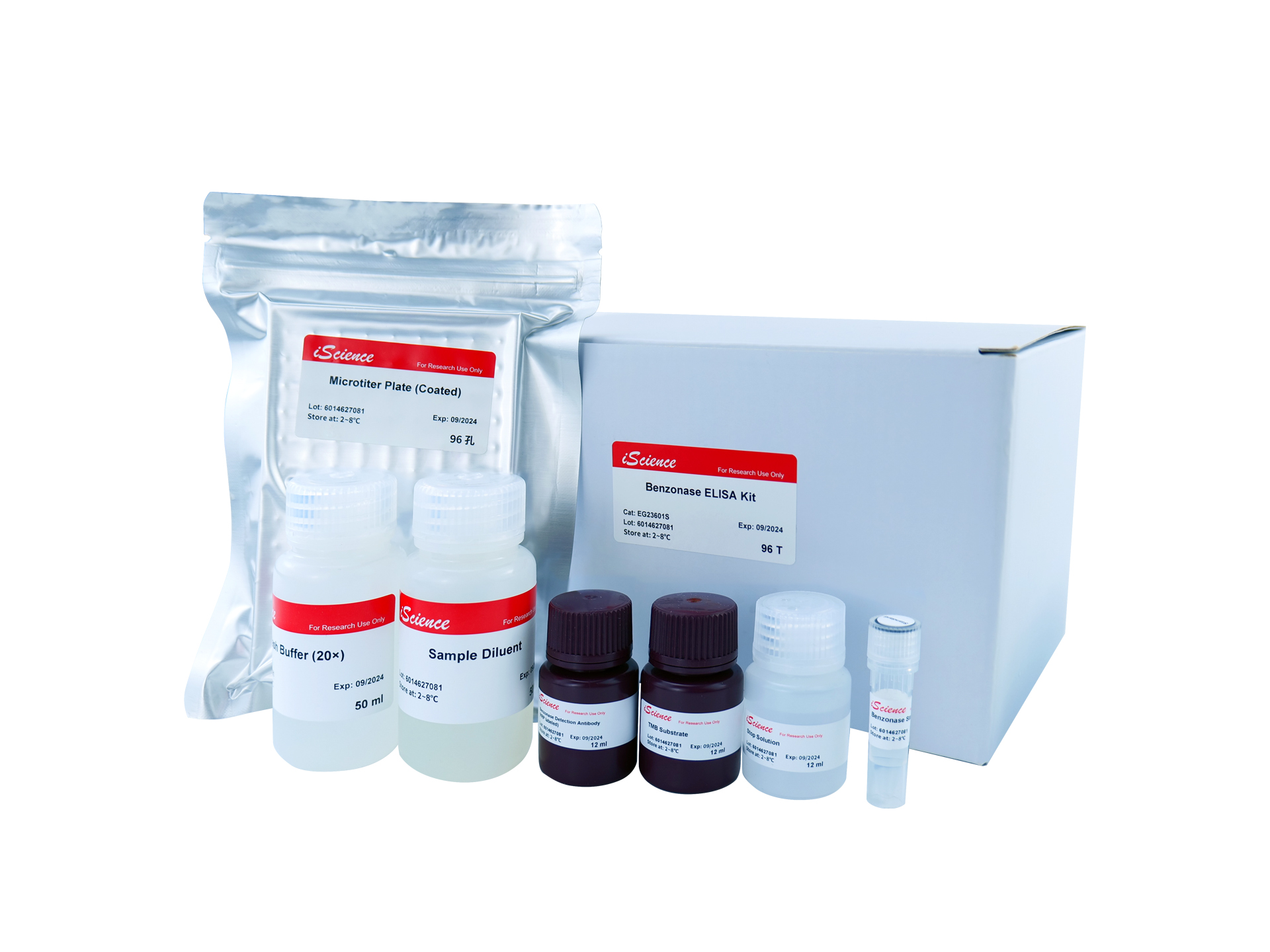
Benzonase ELISA Kit
EG23601S
96 Tests

Not I Restriction Enzyme
B2016623
500 Units
K562-HLA-G0101 Overexpressing Cell Line
RG-1214
5x 10^6
Yeast Poly (A) Polymerase
RNT-006-S
30000 Units
Recent gezochte producten
Cellubrevin Antibody
MBS9436639-01
0.05 mL
Rat Oxidative Stress Primer Library
ROSL-I
1 set
DTNB (Ellman’s) Thiol Oxidative Stress Assay
1021
1 Kit
OSR1 (Oxidative Stress Responsive 1)
MBS616581-01
0.1 mL
Oxidative Stress Combo Assay Cell Kit
EA-7006
1 Each
Oxidative Stress Combo Assay Blood Kit
EA-7007
1 Each
Oxidative Stress Combo Assay Tissue Kit
EA-7008
1 Each
OSR1 (Oxidative Stress Responsive 1)
O8054
100 µL