
Anti-TCF4 Antibody Picoband®
Kwaliteit
ISO Gecertificeerd
Levering
24-48 uur
Technische Specificaties
Transcription factor 4 (TCF-4) also known as immunoglobulin transcription factor 2 (ITF-2) is a protein that in humans is encoded by the TCF4 gene located on chromosome 18q21.2. This gene encodes transcription factor 4, a basic helix-loop-helix transcription factor. The encoded protein recognizes an Ephrussi-box ('E-box') binding site ('CANNTG') - a motif first identified in immunoglobulin enhancers. This gene is broadly expressed, and may play an important role in nervous system development. Defects in this gene are a cause of Pitt-Hopkins syndrome. In addition, an intronic CTG repeat normally numbering 10-37 repeat units can expand to >50 repeat units and cause Fuchs endothelial corneal dystrophy. Multiple alternatively spliced transcript variants that encode different proteins have been described.
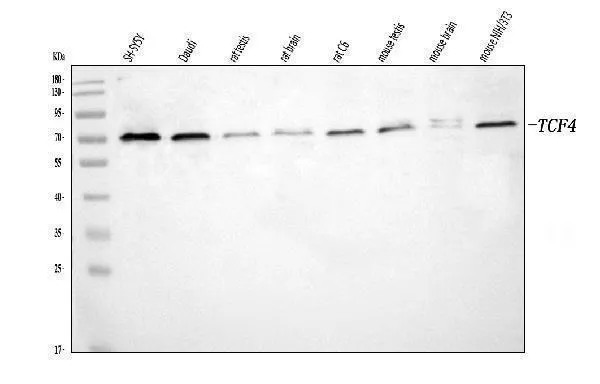
Boster Bio Anti-TCF4 Antibody Picoband® catalog # A00674-2. Tested in ELISA, WB applications. This antibody reacts with Human, Mouse, Rat. The brand Picoband indicates this is a premium antibody that guarantees superior quality, high affinity, and strong signals with minimal background in Western blot applications. Only our best-performing antibodies are designated as Picoband, ensuring unmatched performance.
Serine/threonine-protein kinase Sgk1; Serum/glucocorticoid-regulated kinase 1; SGK1; SGK
TCF4
6925
P15884
• Rabbit
Human, Mouse, Rat
No cross-reactivity with other proteins.
E.coli-derived human TCF4 recombinant protein (Position: Q147-V176) .
• Polyclonal
Expressed in most tissues with highest levels in the pancreas, followed by placenta, kidney and lung. Isoform 2 is strongly expressed in brain and pancreas, weaker in heart, placenta, lung, liver and skeletal muscle.
WB, ELISA
Drug Metabolism, Metabolic Signaling Pathways, Metabolism, Pathways and Processes, Signal Transduction
Immunogen affinity purified.
Adding 0.2 ml of distilled water will yield a concentration of 500 μg/ml.
Lyophilized
Adding 0.2 ml of distilled water will yield a concentration of 500 μg/ml.
Serine/threonine-protein kinase which is involved in the regulation of a wide variety of ion channels, membrane transporters, cellular enzymes, transcription factors, neuronal excitability, cell growth, proliferation, survival, migration and apoptosis. Plays an important role in cellular stress response. Contributes to regulation of renal Na+ retention, renal K+ elimination, salt appetite, gastric acid secretion, intestinal Na+/H+ exchange and nutrient transport, insulin-dependent salt sensitivity of blood pressure, salt sensitivity of peripheral glucose uptake, cardiac repolarization and memory consolidation. Up-regulates Na+ channels: SCNN1A/ENAC, SCN5A and ASIC1/ACCN2, K+ channels: KCNJ1/ROMK1, KCNA1-5, KCNQ1-5 and KCNE1, epithelial Ca2+ channels: TRPV5 and TRPV6, chloride channels: BSND, CLCN2 and CFTR, glutamate transporters: SLC1A3/EAAT1, SLC1A2 /EAAT2, SLC1A1/EAAT3, SLC1A6/EAAT4 and SLC1A7/EAAT5, amino acid transporters: SLC1A5/ASCT2, SLC38A1/SN1 and SLC6A19, creatine transporter: SLC6A8, Na+/dicarboxylate cotransporter: SLC13A2/NADC1, Na+-dependent phosphate cotransporter: SLC34A2/NAPI-2B, glutamate receptor: GRIK2/GLUR6. Up-regulates carriers: SLC9A3/NHE3, SLC12A1/NKCC2, SLC12A3/NCC, SLC5A3/SMIT, SLC2A1/GLUT1, SLC5A1/SGLT1 and SLC15A2/PEPT2. Regulates enzymes: GSK3A/B, PMM2 and Na+/K+ ATPase, and transcription factors: CTNNB1 and nuclear factor NF-kappa-B. Stimulates sodium transport into epithelial cells by enhancing the stability and expression of SCNN1A/ENAC. This is achieved by phosphorylating the NEDD4L ubiquitin E3 ligase, promoting its interaction with 14-3-3 proteins, thereby preventing it from binding to SCNN1A/ENAC and targeting it for degradation. Regulates store-operated Ca (+2) entry (SOCE) by stimulating ORAI1 and STIM1. Regulates KCNJ1/ROMK1 ly via its phosphorylation or inly via increased interaction with SLC9A3R2/NHERF2. Phosphorylates MDM2 and activates MDM2-dependent ubiquitination of p53/TP53. Phosphorylates MAPT/TAU and mediates microtubule depolymerization and neurite formation in hippocampal neurons. Phosphorylates SLC2A4/GLUT4 and up-regulates its activity. Phosphorylates APBB1/FE65 and promotes its localization to the nucleus. Phosphorylates MAPK1/ERK2 and activates it by enhancing its interaction with MAP2K1/MEK1 and MAP2K2/MEK2. Phosphorylates FBXW7 and plays an inhibitory role in the NOTCH1 signaling. Phosphorylates FOXO1 resulting in its relocalization from the nucleus to the cytoplasm. Phosphorylates FOXO3, promoting its exit from the nucleus and interference with FOXO3-dependent transcription. Phosphorylates BRAF and MAP3K3/MEKK3 and inhibits their activity. Phosphorylates SLC9A3/NHE3 in response to dexamethasone, resulting in its activation and increased localization at the cell membrane. Phosphorylates CREB1. Necessary for vascular remodeling during angiogenesis. Sustained high levels and activity may contribute to conditions such as hypertension and diabetic nephropathy. Isoform 2 exhibited a greater effect on cell plasma membrane expression of SCNN1A/ENAC and Na+ transport than isoform 1.
1. Amiel, J., Rio, M., de Pontual, L., Redon, R., Malan, V., Boddaert, N., Plouin, P., Carter, N. P., Lyonnet, S., Munnich, A., Colleaux, L. Mutations in TCF4, encoding a class I basic helix-loop-helix transcription factor, are responsible for Pitt-Hopkins syndrome, a severe epileptic encephalopathy associated with autonomic dysfunction. Am. J. Hum. Genet. 80: 988-993, 2007. 2. Breschel, T. S., McInnis, M. G., Margolis, R. L., Sirugo, G., Corneliussen, B., Simpson, S. G., McMahon, F. J., MacKinnon, D. F., Xu, J. F., Pleasant, N., Huo, Y., Ashworth, R. G., Grundstrom, C., Grundstrom, T., Kidd, K. K., DePaulo, J. R., Ross, C. A. A novel, heritable, expanding CTG repeat in an intron of the SEF2-1 gene on chromosome 18q21.1. Hum. Molec. Genet. 6: 1855-1863, 1997. 3. Brockschmidt, A., Todt, U., Ryu, S., Hoischen, A., Landwehr, C., Birnbaum, S., Frenck, W., Radlwimmer, B., Lichter, P., Engels, H., Driever, W., Kubisch, C., Weber, R. G. Severe mental retardation with breathing abnormalities (Pitt-Hopkins syndrome) is caused by haploinsufficiency of the neuronal bHLH transcription factor TCF4. Hum. Molec. Genet. 16: 1488-1494, 2007.
At -20°C for one year from date of receipt. After reconstitution, at 4°C for one month. It can also be aliquotted and stored frozen at -20°C for six months. Avoid repeated freezing and thawing.
https://www.bosterbio.com/msds?sku=A00674-2
129383 MW
71 kDa
Serum/glucocorticoid regulated kinase 1
Mitochondrion. Endoplasmic reticulum membrane. Cell membrane. Nucleus. Cytoplasm.
Thrombospondin-1
Rabbit IgG
Each vial contains 4 mg Trehalose, 0.9 mg NaCl, 0.2 mg Na2HPO4.
Beschrijving
Boster Bio Anti-TCF4 Antibody Picoband® catalog # A00674-2. Tested in ELISA, WB applications. This antibody reacts with Human, Mouse, Rat. The brand Picoban
Specificaties
Recent bekeken producten

Biotin-Recombinant (sf9) Marburg virus glycoprotein (Musoke, HA-tag, >95%), purified
MVGP16-BTN
100 µL
MARV VP40/Marburg VP40 Protein (N-His, Lake Victoria marburgvirus (strain Musoke-80) (MARV) (Marburg virus (strain Kenya/Musoke/1980) ) )
P505862
100 µg
Hettich Centrifuge Rotanta 460R Refrigerated Large Volume
CEN0703
1 Each
X4RF Refrigerated Centrifuge
75009936
1 Each
Drug Stability Chamber
500-DSC102
1 Unit
Modular Incubator Chamber
MIC-101
1 Unit
CYP707A2 Antibody
GTR17947107
2 mg

SsDNA Assay Kit
12645ES60
100 Tests
Recent gezochte producten
Biotin-Recombinant (sf9) Marburg virus glycoprotein (Musoke, HA-tag, >95%), purified
MVGP16-BTN
100 µL
MARV VP40/Marburg VP40 Protein (N-His, Lake Victoria marburgvirus (strain Musoke-80) (MARV) (Marburg virus (strain Kenya/Musoke/1980) ) )
P505862
100 µg
X4RF Refrigerated Centrifuge
75009936
1 Each
Low Speed Refrigerated Centrifuge
LX104LSR
1 Unit
Low Speed Refrigerated Centrifuge
LX117LSR
1 Unit
Low Speed Refrigerated Centrifuge
LX124LSR
1 Unit
Blood Bank Refrigerator
LX4000BBR
1 Unit
Blood Bank Refrigerator
LX4002BBR
1 Unit