
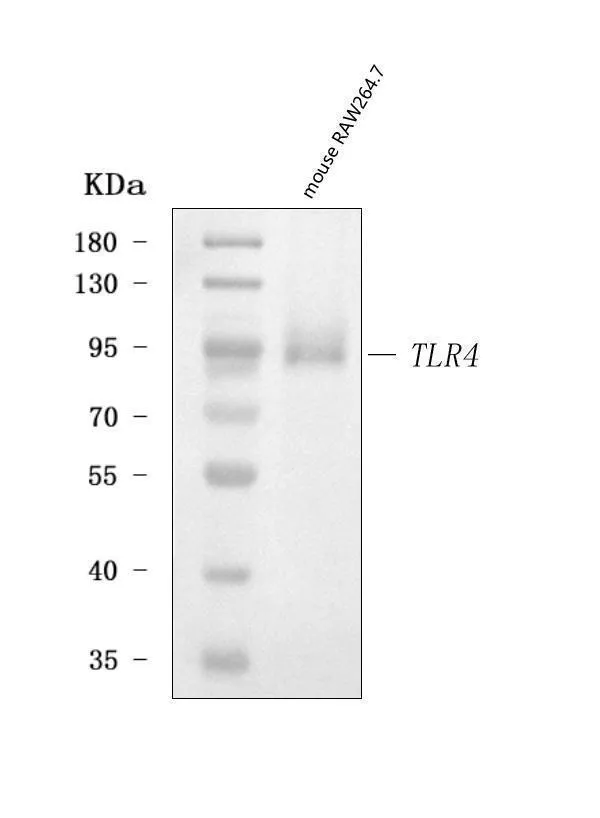
Anti-Tlr4 Antibody Picoband®
Kwaliteit
ISO Gecertificeerd
Levering
24-48 uur
Technische Specificaties
Toll-like receptor 4 is a protein that in humans is encoded by the TLR4 gene. This gene belongs to the evolutionarily-conserved Toll-like receptor family, whose members are type-1 transmembrane proteins that are involved in innate immunity. Toll-like receptors are characterized by an extracellular leucine-rich repeat domain that functions in ligand recognition and an intracellular toll/interleukin-1 receptor-like domain that is crucial for signal transduction. The receptor encoded by this gene mediates the innate immune response to bacterial lipopolysaccharide, a major component of the outer membrane of Gram-negative bacteria, through synthesis of pro-inflammatory cytokines and chemokines. In addition, this protein can recognize other pathogens from Gram-negative and Gram-positive bacteria as well as viral components. Mice deficient in this gene display a number of immune response-related phenotypes including hyporesponsiveness to bacterial lipopolysaccharide and increased levels of respiratory syncytial virus compared to controls.
Boster Bio Anti-Tlr4 Antibody Picoband® catalog # A00017-3. Tested in ELISA, WB applications. This antibody reacts with Mouse. The brand Picoband indicates this is a premium antibody that guarantees superior quality, high affinity, and strong signals with minimal background in Western blot applications. Only our best-performing antibodies are designated as Picoband, ensuring unmatched performance.
Hypoxia-inducible factor 1-alpha; HIF-1-alpha; HIF1-alpha; ARNT-interacting protein; Basic-helix-loop-helix-PAS protein MOP1; Class E basic helix-loop-helix protein 78; bHLHe78; PAS domain-containing protein 8; HIF1A; BHLHE78, MOP1
Tlr4
21898
Q9QUK6
• Rabbit
Mouse
No cross-reactivity with other proteins.
E.coli-derived mouse Tlr4 recombinant protein (Position: N26-E827) .
• Polyclonal
Expressed in most tissues with highest levels in kidney and heart. Overexpressed in the majority of common human cancers and their metastases, due to the presence of intratumoral hypoxia and as a result of mutations in genes encoding oncoproteins and tumor suppressors. A higher level expression seen in pituitary tumors as compared to the pituitary gland.
WB, ELISA
Cancer, Cell Type Markers, Growth Factors, Growth Factors/Hormones, Oncoproteins, Protein Phosphorylation, Receptor Tyrosine Kinases, Signal Transduction, Tags & Cell Markers, Tumor Associated, Tumor Biomarkers, Tumor Immunology, Tumor-Associated Antigens, Tyrosine Kinases
Immunogen affinity purified.
Adding 0.2 ml of distilled water will yield a concentration of 500 μg/ml.
Lyophilized
Adding 0.2 ml of distilled water will yield a concentration of 500 μg/ml.
Functions as a master transcriptional regulator of the adaptive response to hypoxia. Under hypoxic conditions, activates the transcription of over 40 genes, including erythropoietin, glucose transporters, glycolytic enzymes, vascular endothelial growth factor, HILPDA, and other genes whose protein products increase oxygen delivery or facilitate metabolic adaptation to hypoxia. Plays an essential role in embryonic vascularization, tumor angiogenesis and pathophysiology of ischemic disease. Heterodimerizes with ARNT; heterodimer binds to core DNA sequence 5'-TACGTG-3' within the hypoxia response element (HRE) of target gene promoters (By similarity) . Activation requires recruitment of transcriptional coactivators such as CREBBP and EP300. Activity is enhanced by interaction with both, NCOA1 or NCOA2. Interaction with redox regulatory protein APEX seems to activate CTAD and potentiates activation by NCOA1 and CREBBP. Involved in the axonal distribution and transport of mitochondria in neurons during hypoxia.
1. Aderem, A., Ulevitch, R. J. Toll-like receptors in the induction of the innate immune response. Nature 406: 782-787, 2000. 2. Andonegui, G., Bonder, C. S., Green, F., Mullaly, S. C., Zbytnuik, L., Raharjo, E., Kubes, P. Endothelium-derived Toll-like receptor-4 is the key molecule in LPS-induced neutrophil sequestration into lungs. J. Clin. Invest. 111: 1011-1020, 2003. Note: Erratum: J. Clin. Invest. 112: 1264 only, 2003. 3. Andonegui, G., Zhou, H., Bullard, D., Kelly, M. M., Mullaly, S. C., McDonald, B., Long, E. M., Robbins, S. M., Kubes, P. Mice that exclusively express TLR4 on endothelial cells can efficiently clear a lethal systemic gram-negative bacterial infection. J. Clin. Invest. 119: 1921-1930, 2009.
At -20°C for one year from date of receipt. After reconstitution, at 4°C for one month. It can also be aliquotted and stored frozen at -20°C for six months. Avoid repeated freezing and thawing.
https://www.bosterbio.com/msds?sku=A00017-3
137910 MW
96 kDa
Hypoxia inducible factor 1 subunit alpha
Isoform 1: Cell membrane; Single-pass type I membrane protein. Cytoplasm, perinuclear region. Nucleus. Translocation to the nucleus requires endocytosis, probably endosomal sorting and is mediated by importin beta-1/KPNB1.
Receptor tyrosine-protein kinase erbB-2
Rabbit IgG
Each vial contains 4 mg Trehalose, 0.9 mg NaCl, 0.2 mg Na2HPO4.
Beschrijving
Boster Bio Anti-Tlr4 Antibody Picoband® catalog # A00017-3. Tested in ELISA, WB applications. This antibody reacts with Mouse. The brand Picoband indicates
Specificaties
Recent bekeken producten

Arachis hypogaea Lectin (PNA) - Biotinylated
21510020-1
5mg
1,4- Dioxane Pure
1041330 500
500 mL
Benzonase ELISA Kit
EG23601S
96 Tests

Not I Restriction Enzyme
B2016623
500 Units
K562-HLA-G0101 Overexpressing Cell Line
RG-1214
5x 10^6
Yeast Poly (A) Polymerase
RNT-006-S
30000 Units
Arachis hypogaea lectin (PNA)
05-0116-10mg
10 mg
Anti-APOE2 mouse monoclonal antibody
TD-AB0132
100 µg