
Anti-TPR Antibody Picoband®
Kwaliteit
ISO Gecertificeerd
Levering
24-48 uur
Technische Specificaties
The tetratricopeptide repeat (TPR) is a structural motif. This gene encodes a large coiled-coil protein that forms intranuclear filaments attached to the inner surface of nuclear pore complexes (NPCs) . The protein ly interacts with several components of the NPC. It is required for the nuclear export of mRNAs and some proteins. Oncogenic fusions of the 5' end of this gene with several different kinase genes occur in some neoplasias.
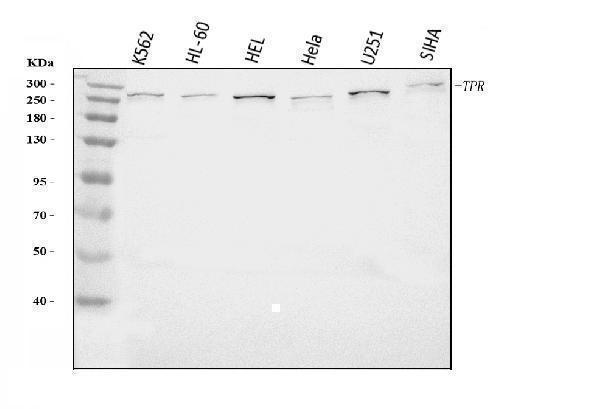
Boster Bio Anti-TPR Antibody Picoband® catalog # A00695-2. Tested in Flow Cytometry, IF, IHC, ICC, WB applications. This antibody reacts with Human, Mouse, Rat. The brand Picoband indicates this is a premium antibody that guarantees superior quality, high affinity, and strong signals with minimal background in Western blot applications. Only our best-performing antibodies are designated as Picoband, ensuring unmatched performance.
Nucleoprotein TPR; Megator; NPC-associated intranuclear protein; Translocated promoter region protein; TPR
TPR
7175
P12270
• Rabbit
Human, Mouse, Rat
No cross-reactivity with other proteins.
A synthetic peptide corresponding to a sequence at the N-terminus of human TPR, which shares 90.6% amino acid (aa) sequence identity with mouse and rat TPR.
• Polyclonal
Expressed in esophagus, ovary, liver, skin, smooth muscles, cerebrum and fetal cerebellum (at protein level) . Highest in testis, lung, thymus, spleen and brain, lower levels in heart, liver and kidney.
WB, IHC, ICC, IF, Flow Cytometry
Cancer, Cell Cycle, DNA/RNA, Epigenetics and Nuclear Signaling, Kinases/Phosphatases, Nuclear Import/Export, Protein Trafficking, RNA Processing, Signal Transduction
Immunogen affinity purified.
Adding 0.2 ml of distilled water will yield a concentration of 500 μg/ml.
Lyophilized
Adding 0.2 ml of distilled water will yield a concentration of 500 μg/ml.
Component of the nuclear pore complex (NPC), a complex required for the trafficking across the nuclear envelope. Functions as a scaffolding element in the nuclear phase of the NPC essential for normal nucleocytoplasmic transport of proteins and mRNAs, plays a role in the establishment of nuclear-peripheral chromatin compartmentalization in interphase, and in the mitotic spindle checkpoint signaling during mitosis. Involved in the quality control and retention of unspliced mRNAs in the nucleus; in association with NUP153, regulates the nuclear export of unspliced mRNA species bearing constitutive transport element (CTE) in a NXF1- and KHDRBS1-independent manner. Negatively regulates both the association of CTE-containing mRNA with large polyribosomes and translation initiation. Does not play any role in Rev response element (RRE) -mediated export of unspliced mRNAs. Implicated in nuclear export of mRNAs transcribed from heat shock gene promoters; associates both with chromatin in the HSP70 promoter and with mRNAs transcribed from this promoter under stress-induced conditions. Modulates the nucleocytoplasmic transport of activated MAPK1/ERK2 and huntingtin/HTT and may serve as a docking site for the XPO1/CRM1-mediated nuclear export complex. According to some authors, plays a limited role in the regulation of nuclear protein export (PubMed:22253824 and PubMed:11952838) . Plays also a role as a structural and functional element of the perinuclear chromatin distribution; involved in the formation and/or maintenance of NPC-associated perinuclear heterochromatin exclusion zones (HEZs) . Finally, acts as a spatial regulator of the spindle-assembly checkpoint (SAC) response ensuring a timely and effective recruitment of spindle checkpoint proteins like MAD1L1 and MAD2L1 to unattached kinetochore during the metaphase-anaphase transition before chromosome congression. Its N-terminus is involved in activation of oncogenic kinases.
1. Gonzatti-Haces, M., Seth, A., Park, M., Copeland, T., Oroszlan, S., Vande Woude, G. F. Characterization of the TPR-MET oncogene p65 and the MET protooncogene p140 protein-tyrosine kinases. Proc. Nat. Acad. Sci. 85: 21-25, 1988. 2. Miranda, C., Minoletti, F., Greco, A., Sozzi, G., Pierotti, M. A. Refined localization of the human TPR gene to chromosome 1q25 by in situ hybridization. Genomics 23: 714-715, 1994.
At -20°C for one year from date of receipt. After reconstitution, at 4°C for one month. It can also be aliquotted and stored frozen at -20°C for six months. Avoid repeated freezing and thawing.
https://www.bosterbio.com/msds?sku=A00695-2
267 kDa
6
Translocated promoter region, nuclear basket protein
Nucleus.
Rabbit IgG
Each vial contains 4 mg Trehalose, 0.9 mg NaCl, 0.2 mg Na2HPO4.
Beschrijving
Boster Bio Anti-TPR Antibody Picoband® catalog # A00695-2. Tested in Flow Cytometry, IF, IHC, ICC, WB applications. This antibody reacts with Human, Mouse,
Specificaties
Recent bekeken producten

Anti-TAT (Thrombin-antithrombin) Antibody
ABS 014-22-1
1000 µL
Anti-APOE2 mouse monoclonal antibody
TD-AB0132
100 µg
CD35 (CR1) mouse monoclonal antibody, clone J3D3, Azide Free
BM2364
0.2 mg
Anti-KIR2DL1 (Rabbit, Monoclonal, Rabbit mAb)
A115392
100 µL
Stains-all
03943-5
5 g
Sudan Blue II;Oil Blue 35
TRC-S688913-500MG
500 mg
Nile Blue A
N8430-01
1 g
Human Apolipoprotein E2 (Apo E2) Antibody
22210-05011
150 µg
Recent gezochte producten
CEACAM8 (human) monoclonal antibody (GM2H6)
MBS566381-01
0.1 mg
Human monoclonal antibody to CRP, clone 10A2
R1-262-100-01
100 µg
Human monoclonal antibody to MPO, clone 4D7
R1-295-100-01
100 µg
Human monoclonal antibody to sST2, clone 2B6
R1-265-100-01
100 µg
Human monoclonal antibody to CHI3L1, clone 12A3
R1-235-100-01
100 µg
Human monoclonal antibody to CHI3L1, clone 13D10
R1-236-100-01
100 µg
Human monoclonal antibody to PAI-1, clone 11D6
R1-222-100-01
100 µg
Human monoclonal antibody to NGAL, clone 5B12
R1-309-100-01
100 µg