
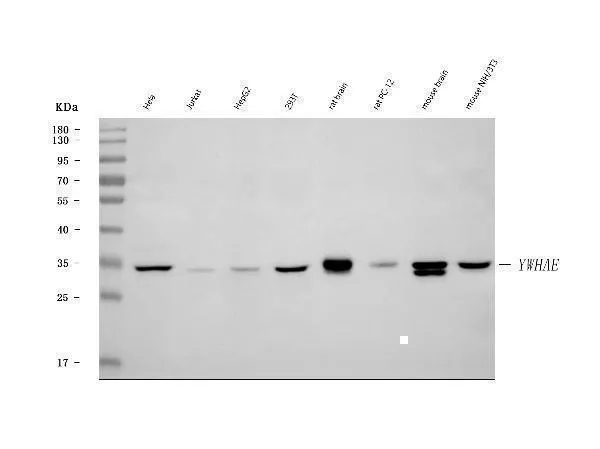
Anti-YWHAE Antibody Picoband®
Kwaliteit
ISO Gecertificeerd
Levering
24-48 uur
Technische Specificaties
14-3-3 protein epsilon is a protein that in humans is encoded by the YWHAE gene. This gene product belongs to the 14-3-3 family of proteins which mediate signal transduction by binding to phosphoserine-containing proteins. This highly conserved protein family is found in both plants and mammals, and this protein is 100% identical to the mouse ortholog. It interacts with CDC25 phosphatases, RAF1 and IRS1 proteins, suggesting its role in diverse biochemical activities related to signal transduction, such as cell division and regulation of insulin sensitivity. It has also been implicated in the pathogenesis of small cell lung cancer. Two transcript variants, one protein-coding and the other non-protein-coding, have been found for this gene.
Boster Bio Anti-YWHAE Antibody Picoband® catalog # A01687-5. Tested in ELISA, IF, IHC, ICC, WB applications. This antibody reacts with Human, Mouse, Rat. The brand Picoband indicates this is a premium antibody that guarantees superior quality, high affinity, and strong signals with minimal background in Western blot applications. Only our best-performing antibodies are designated as Picoband, ensuring unmatched performance.
Periaxin; PRX; KIAA1620
YWHAE
7531
P62258
• Rabbit
Human, Mouse, Rat
No cross-reactivity with other proteins.
E.coli-derived human YWHAE recombinant protein (Position: Q16-L163) .
• Polyclonal
Detected in spinal cord (PubMed:11133365) . Isoform 1 and isoform 2 are found in sciatic nerve and Schwann cells (PubMed:11157804) .
ELISA, IF, IHC, ICC, WB
Adapters, Signal Transduction, Transmembrane
Immunogen affinity purified.
Adding 0.2 ml of distilled water will yield a concentration of 500 μg/ml.
Lyophilized
Adding 0.2 ml of distilled water will yield a concentration of 500 μg/ml.
Scaffolding protein that functions as part of a dystroglycan complex in Schwann cells, and as part of EZR and AHNAK-containing complexes in eye lens fiber cells. Required for the maintenance of the peripheral myelin sheath that is essential for normal transmission of nerve impulses and normal perception of sensory stimuli. Required for normal transport of MBP mRNA from the perinuclear to the paranodal regions. Required for normal remyelination after nerve injury. Required for normal elongation of Schwann cells and normal length of the internodes between the nodes of Ranvier. The demyelinated nodes of Ranvier permit saltatory transmission of nerve impulses; shorter internodes cause slower transmission of nerve impulses. Required for the formation of appositions between the abaxonal surface of the myelin sheath and the Schwann cell plasma membrane; the Schwann cell cytoplasm is restricted to regions between these appositions. Required for the formation of Cajal bands and of Schmidt-Lanterman incisures that correspond to short, cytoplasm-filled regions on myelinated nerves. Recruits DRP2 to the Schwann cell plasma membrane. Required for normal protein composition of the eye lens fiber cell plasma membrane and normal eye lens fiber cell morphology.
1. Bi, W., Sapir, T., Shchelochkov, O. A., Zhang, F., Withers, M. A., Hunter, J. V., Levy, T., Shinder, V., Peiffer, D. A., Gunderson, K. L., Nezarati, M. M., Shotts, V. A., and 13 others. Increased LIS1 expression affects human and mouse brain development. Nature Genet. 41: 168-177, 2009. 2. Cardoso, C., Leventer, R. J., Ward, H. L., Toyo-oka, K., Chung, J., Gross, A., Martin, C. L., Allanson, J., Pilz, D. T., Olney, A. H., Mutchinick, O. M., Hirotsune, S., Wynshaw-Boris, A., Dobyns, W. B., Ledbetter, D. H. Refinement of a 400-kb critical region allows genotypic differentiation between isolated lissencephaly, Miller-Dieker syndrome, and other phenotypes secondary to deletions of 17p13.3. Am. J. Hum. Genet. 72: 918-930, 2003. 3. Chong, S. S., Tanigami, A., Roschke, A. V., Ledbetter, D. H. 14-3-3-epsilon has no homology to LIS1 and lies telomeric to it on chromosome 17p13.3 outside the Miller-Dieker syndrome chromosome region. Genome Res. 6: 735-741, 1996.
At -20°C for one year from date of receipt. After reconstitution, at 4°C for one month. It can also be aliquotted and stored frozen at -20°C for six months. Avoid repeated freezing and thawing.
https://www.bosterbio.com/msds?sku=A01687-5
32 kDa
Periaxin
Isoform 1: Cell membrane.
Rabbit IgG
Each vial contains 4 mg Trehalose, 0.9 mg NaCl, 0.2 mg Na2HPO4.
Beschrijving
Boster Bio Anti-YWHAE Antibody Picoband® catalog # A01687-5. Tested in ELISA, IF, IHC, ICC, WB applications. This antibody reacts with Human, Mouse, Rat. Th
Specificaties
Recent bekeken producten

Recombinant TAFV GP1 Protein, C-Fc
EVV03609
100 μg
Gabbr1 Mouse Monoclonal Antibody [Clone ID: S93A-49]
TA326530
100 µg
BSA-Myc/DDK Control Protein
AR100025
50 µL
NH-6
ABC-TC0826
1 Vial
Anti-TAT (Thrombin-antithrombin) Antibody
ABS 014-22-1
1000 µL
Anti-APOE2 mouse monoclonal antibody
TD-AB0132
100 µg
CD35 (CR1) mouse monoclonal antibody, clone J3D3, Azide Free
BM2364
0.2 mg
Anti-KIR2DL1 (Rabbit, Monoclonal, Rabbit mAb)
A115392
100 µL
Recent gezochte producten
Recombinant TAFV GP1 Protein, C-Fc
EVV03609
100 μg
Fluorescein Conjugated Affinity Purified Anti-MOUSE IgG + IgM (H&L) (GOAT) Minimum Cross Reactivity to Bovine, Horse and Human S
GWB-5CB439
1 mg
Horse Polyclonal Horse anti-Goat IgG ImmPRESS(TM) Secondary Antibody [HRP Polymer]
MP-7405-NB-50mL
50 mL
Horse Polyclonal Horse anti-Rabbit IgG ImmPRESS(TM) Secondary Antibody [HRP Polymer]
MP-7401-NB-15mL
15 mL
Horse Polyclonal Horse anti-Mouse IgG ImmPRESS(TM) Secondary Antibody [AP Polymer]
MP-5402-NB-50mL
50 mL
Horse Polyclonal Horse anti-Goat IgG ImmPRESS(TM) Secondary Antibody [HRP Polymer]
MP-7405-NB-15mL
15 mL
Horse Polyclonal Horse anti-Mouse ImmPRESS(TM) VR Secondary Antibody [HRP Polymer]
MP-6402-NB
15 mL
Horse Polyclonal Horse anti-Mouse IgG ImmPRESS(TM) Secondary Antibody [AP Polymer]
MP-5402-NB-15mL
15 mL