

CLDN16 Antilichaam - C-terminalgebied: FITC (ARP33632 P050-FITC)
Kwaliteit
ISO Gecertificeerd
Levering
24-48 uur
Technische Specificaties
Claudin 16
HOMG3, PCLN1
10686
Q9Y5I7
NP_006571
• Rabbit
Human, Mouse, Rat, Cow, Dog, Horse, Pig, Rabbit
The immunogen is a synthetic peptide directed towards the C terminal region of human CLDN16
Tight junctions represent one mode of cell-to-cell adhesion in epithelial or endothelial cell sheets, forming continuous seals around cells and serving as a physical barrier to prevent solutes and water from passing freely through the paracellular space. These junctions are comprised of sets of continuous networking strands in the outwardly facing cytoplasmic leaflet, with complementary grooves in the inwardly facing extracytoplasmic leaflet. Claudin-16, a member of the claudin family, is an integral membrane protein and a component of tight junction strands. It is found primarily in the kidneys, specifically in the thick ascending limb of Henle, where it acts as either an intercellular pore or ion concentration sensor to regulate the paracellular resorption of magnesium ions. Defects in the corresponding gene are a cause of primary hypomagnesemia, which is characterized by massive renal magnesium wasting with hypomagnesemia and hypercalciuria, resulting in nephrocalcinosis and renal failure.Tight junctions represent one mode of cell-to-cell adhesion in epithelial or endothelial cell sheets, forming continuous seals around cells and serving as a physical barrier to prevent solutes and water from passing freely through the paracellular space. These junctions are comprised of sets of continuous networking strands in the outwardly facing cytoplasmic leaflet, with complementary grooves in the inwardly facing extracytoplasmic leaflet. The protein encoded by this gene, a member of the claudin family, is an integral membrane protein and a component of tight junction strands. It is found primarily in the kidneys, specifically in the thick ascending limb of Henle, where it acts as either an intercellular pore or ion concentration sensor to regulate the paracellular resorption of magnesium ions. Defects in this gene are a cause of primary hypomagnesemia, which is characterized by massive renal magnesium wasting with hypomagnesemia and hypercalciuria, resulting in nephrocalcinosis and renal failure. Publication Note: This RefSeq record includes a subset of the publications that are available for this gene. Please see the Entrez Gene record to access additional publications.
APP; TJP1
• Polyclonal
FITC: Fluorescein Isothiocyanate
Polyclonal Antibody
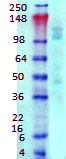
WB
Affinity Purified
0.5 mg/ml
Cow: 86%; Dog: 86%; Horse: 93%; Human: 100%; Mouse: 86%; Pig: 86%; Rabbit: 93%; Rat: 86%
Liquid. Purified antibody supplied in 1x PBS buffer.
All conjugated antibodies should be stored in light-protected vials or covered with a light protecting material (i.e. aluminum foil) . Conjugated antibodies are stable for at least 12 months at 4C. If longer storage is desired (24 months), conjugates may be diluted with up to 50% glycerol and stored at -20C to -80C. Freezing and thawing conjugated antibodies will compromise enzyme activity as well as antibody binding.
34kDa
Muller, D., et al., (2003) Am. J. Hum. Genet. 73 (6), 1293-1301
Wet Ice
305
CLDN16
CLDN16
Rabbit
Claudin-16
NM_006580
FLAGAVLTCCLYLFKDVGPERNYPYSLRKAYSAAGVSMAKSYSAPRTETA
Beschrijving
CLDN16 Antilichaam - C-terminalgebied: FITC (ARP33632 P050-FITC) Beschikbaar in 100 µL. Bestel eenvoudig online met snelle levering.
Specificaties
Recent bekeken producten
3-D Life Dextran-PEG Hydrogel SG
G92-1
1 Each
Plant Preservative Mixture (PPM)
P5550-01
25 mL
PhaseShield™ Gel Tubes, Heavy (50x 2ml)
M2302-05H
50x 2 mL
Parvovirus B19
OT020
1 Each
Anti- Protein A Antibody
GWB-E66F30
1 mL
Recombinant TAFV GP1 Protein, C-Fc
EVV03609
100 μg
Gabbr1 Mouse Monoclonal Antibody [Clone ID: S93A-49]
TA326530
100 µg
BSA-Myc/DDK Control Protein
AR100025
50 µL